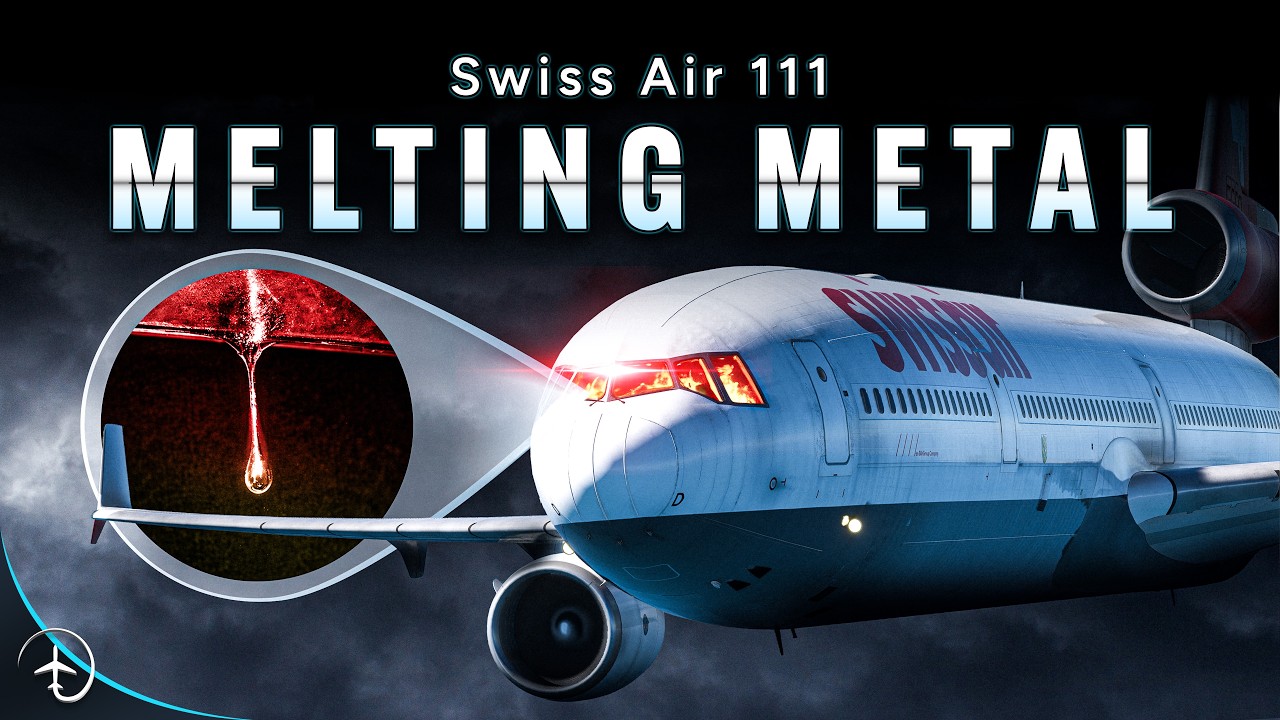
Original source: Mentour Pilot
This video from Mentour Pilot covered a lot of ground. 10 segments stood out as worth your time. Everything below links directly to the timestamp in the original video.
The crew followed their checklist to the letter. That single, prescribed action is what turned a serious emergency into an unsurvivable one.
A Single Checklist Step Turned a Controllable Fire into a Fatal Catastrophe
Switching off the cabin AC bus — a standard step in the smoke-elimination checklist — catastrophically reversed the airflow dynamics above the cockpit. Until that moment, recirculation fans had been drawing smoke away from the crew; deactivating them removed that buffer, and the pressure gradient shifted, driving flames and smoke forward over the cockpit rear wall and directly into the circuit breaker panels that powered the aircraft's critical systems. Within seconds, Autopilot 2 disconnected, yaw dampers failed, flight control computer channels dropped out, and the flight data recorder went dark. The captain's primary display unit lost power entirely. The cockpit voice recorder captured pilots' voices distorting from heat damage to the recording circuits, followed by the sound of ceiling material tearing as molten material dripped onto the observer's station.
What makes this particularly significant is that the crew did exactly what their checklist instructed. The catastrophic outcome was not the product of pilot error but of a procedure designed for a fire environment that the aircraft's designers had never anticipated — one where the hidden spaces above the cockpit contained flammable insulation, inadequate wiring, and no fire detection whatsoever.
"Hand flying a giant airliner at night with the ceiling above you on fire and with the oxygen masks on, barely being able to communicate and with only a tiny set of standby gauges."
Known Fire Risk in Aircraft Insulation Went Unaddressed Because Regulations Did Not Require Action
By the late 1990s, regulators and airlines already knew that MPET insulation — the mylar-wrapped fiberglass lining the hidden spaces of commercial aircraft — could sustain and propagate a fire. There had been fires involving MPET-covered insulation on three other MD-11s, and test data showed that newer, safer materials existed. Yet the FAA treated replacement as an optional improvement rather than a mandatory airworthiness directive, partly because the hidden spaces where insulation sat faced lower flammability standards than passenger cabins or designated fire zones — areas considered less critical to immediate human survival. Airlines, including Swissair, predictably left the original material in place.
The regulatory logic that exempted hidden structural spaces from strict flammability rules rested on the assumption that fires there would be detectable and controllable. Swissair Flight 111 proved that assumption catastrophically wrong.
Fragmented Oversight of In-Flight Entertainment Installation Left Fatal Wiring Flaw Undetected
The short circuit that ignited the fire originated in the power wiring for Swissair's in-flight entertainment system — a system that drew too much current to connect to the aircraft's cabin buses and had instead been routed to Main AC Bus 2, a high-capacity bus designed to supply hydraulic pumps. Four 15-amp circuit breakers nominally protected the circuit, but the upstream power source could deliver far more fault energy than those breakers were rated to interrupt cleanly. The arc that resulted generated enough heat to ignite the adjacent MPET insulation without ever triggering a breaker trip. Canada's Transportation Safety Board found that the FAA had delegated installation approval to a subcontractor, which in turn relied on incomplete paperwork from a further web of contractors. No single party had reviewed the final wiring configuration against the aircraft's original design parameters.
This was not a single failure — it was a chain of events born from a certification system that allowed safety-critical modifications to proceed without anyone asking whether the assembled result was safe.
Swissair Flight 111 Reshaped Global Aviation Safety Rules on Fire, Wiring, and Emergency Procedures
In the years following the disaster, aviation authorities enacted a series of concrete, traceable reforms. MPET-covered insulation was banned from both new production aircraft and existing fleets. Flammability tests were rewritten to simulate electrical arcs and particle showers rather than open-flame Bunsen burner exposure — the conditions that had allowed MPET to pass certification in the first place. Rules governing the installation and physical separation of aftermarket equipment such as in-flight entertainment systems were significantly tightened. Most consequentially for flight crews, cockpit smoke stopped being treated as a diagnostic puzzle and became a declaration of immediate emergency: checklists were rewritten to mandate diversion and landing at the nearest suitable airport without delay.
Every one of those changes is a direct inscription of what killed 229 people in September 1998 — written into the wiring standards, insulation specifications, and emergency procedures of every commercial airliner flying today.
"If you see or smell smoke, get the aircraft down."
Aircraft Design Routed First Smoke Away from Cabin, Deceiving Crew into Misdiagnosing the Emergency
At 09:10:38, the first officer detected an unusual smell; moments later, a thin haze drifted from the air conditioning vents on the aft cockpit bulkhead. Because the fire had ignited directly above the cockpit door in the forward overhead attic space, the first smoke was drawn into the cockpit recirculation plenum — but not into the passenger cabin. When smoke emerges from an air conditioning vent, standard aviation training interprets that as an air conditioning fault, not an electrical fire. The crew's initial assessment was therefore not a mistake: it was the most reasonable inference available from what they could observe. A flight attendant confirmed she could smell nothing unusual in the cabin, which appeared to validate the diagnosis.
The investigation would later reveal that the very geometry of the aircraft's ventilation system had concealed the true nature and location of the fire, denying the crew the situational awareness they needed to respond with the urgency the emergency actually demanded.
Final Six Minutes of Swissair Flight 111 Reconstructed from Engine Data and Fused Debris
After the flight recorders lost power, investigators reconstructed the aircraft's final six minutes from physical evidence recovered from the ocean floor. Wear marks on the left seat's track rails indicated the captain had stood up — possibly attempting to fight the fire from the rear of the cockpit — and never returned to his seat. His laminated abnormal procedures manual was recovered with its pages fused together by extreme heat. Approximately four minutes after the recorders stopped, engine number two was manually shut down following what investigators believed was a false fire warning triggered by heat damage to the wiring. Passengers in the forward cabin almost certainly saw smoke and possibly flames during this period.
The aircraft entered an uncontrolled right turn and struck the Atlantic at roughly 300 knots with a steep nose-down attitude, disintegrating on impact and killing all 229 people on board just over 20 minutes after the first officer noticed an unusual smell.
Slow Circuit Breakers and Flammable Insulation Left Aircraft with No Margin Against Electrical Arc
The MD-11's wiring architecture combined three compounding vulnerabilities: it ran electrical cables in close proximity to MPET insulation, a mylar-film material similar to that used in party balloons; it used an older generation of circuit breakers known to trip more slowly than ideal for the available fault current; and the cables in certain areas were thinner than the current loads they carried would have demanded under a stricter design. MPET had passed its certification tests — those tests required only that a Bunsen burner flame take more than 60 seconds to ignite the material — but once ignited, it propagated fire rapidly along its surface. Critically, the tests had never evaluated the material's response to an electrical arc or a shower of hot particles: precisely the conditions most likely to occur behind an aircraft instrument panel.
The certification framework had evaluated a material against a threat that was unlikely and ignored the threat that was almost inevitable.
Investigators Found That Immediate Diversion Would Not Have Saved Swissair Flight 111
One of the investigation's most significant and counterintuitive findings was that the crew's decision to circle and dump fuel rather than divert immediately toward Halifax probably made no material difference to the outcome. By the time the aircraft could have reached any suitable runway, the fire had already consumed the overhead circuit breaker panel, eliminating the autopilot, instrument landing guidance, and autoland capability. The MD-11 was already known as a demanding aircraft to fly on approach — its high approach speed made it notoriously easy to over-rotate on landing — and the additional loss of slats, ground spoilers, and other landing aids meant that even a successful touchdown would almost certainly have ended in an uncontrollable rollout. The aircraft disintegrated on water impact at approximately 300 knots, and the Transportation Safety Board recovered more than 98 percent of the wreckage to reach that conclusion.
The investigation's verdict absolved the crew of the fuel-dump decision while placing responsibility squarely on the constellation of systemic failures — regulatory, material, and design — that had made the fire unsurvivable before the pilots had any reason to believe they faced one.
Revenue-Driven Entertainment System Placed Unanticipated Electrical Load at Heart of Fatal Wiring Failure
Seeking new revenue streams, Swissair installed one of commercial aviation's earliest interactive in-flight entertainment systems in its business class cabin, offering pay-per-play digital content including gambling services. Each passenger seat required what amounted to a full 1990s personal computer, creating a collective electrical demand that the MD-11's original designers had never allocated for non-essential cabin systems. That unanticipated load was the upstream cause of the wiring compromise that ultimately ignited the fire: contractors, unable to connect the system to the cabin buses for which it was too power-hungry, moved it to the aircraft's main AC bus — a connection designed for hydraulic pumps, not entertainment electronics.
The decision illustrates a broader vulnerability in aviation's certification framework: modifications driven by commercial logic, approved piecemeal through delegated oversight, can quietly exceed the safety envelope of an aircraft's original design without any single authority recognising the cumulative risk.
Fuel Dump Decision and Split Checklists Set Stage for Fatal Switch-Off Aboard Swissair 111
Approximately 30 miles from Halifax and still at 21,000 feet — roughly twice the altitude compatible with a straight-in approach — the crew initiated a holding turn to lose height in a controlled manner. The smoke level had increased only marginally and no alarms had sounded, so the situation still appeared manageable. Because the aircraft remained significantly above its maximum landing weight and the symptoms seemed stable, the crew made the decision to dump fuel over the sea before committing to an approach. That procedure required vectors back out over St. Margaret's Bay and added critical minutes to their timeline. Meanwhile, the captain worked through separate, distinct checklists — one for air conditioning smoke, another for smoke or fumes of unknown origin — rather than a single unified emergency procedure. The 'smoke or fumes of unknown origin' checklist directed the crew to systematically deactivate electrical buses to isolate the source; the first major step was switching off the cabin bus.
Summarised from Mentour Pilot · 54:02. All credit belongs to the original creators. Streamed.News summarises publicly available video content.