Airspace & ATC
A curated anthology of the best moments on this topic — drawn from across the full video library, ranked by editorial relevance, with direct links to the exact timestamp in every source session.

GPS jamming is now common enough that airline crews are reviving 1970s navigation techniques. Understanding how INS and DME triangulation work explains why modern airliners carry multiple overlapping systems and why none of them ever truly became obsolete.
Watch full session ↗How Aircraft Navigate Without GPS: INS, DME Triangulation, and the Return of Radio NavWith GPS jamming now a routine hazard on routes across multiple regions, the layered navigation architecture of modern airliners has taken on renewed importance. Inertial Reference Systems — arrays of gyroscopes that track acceleration from a known starting point and require no e
EFB Performance Calculator Produces Takeoff Speeds and Pitch Target for 747-200 DepartureUsing the aircraft's electronic flight bag performance calculator, the correct takeoff parameters for runway 26 Left are determined in a single workflow.
747-200 Takeoff Sequence: EPR Auto-Throttle to INS Nav Mode and Flap Retraction ScheduleThe departure from runway 26 Left demonstrates the full takeoff sequence unique to an older, analogue-era heavy jet.
Clock Jumps and Vanishing Position Data: How Crews Detect GPS Jamming and SpoofingGPS jamming presents an insidious problem because its earliest symptoms are easy to attribute to minor system glitches. The first indicator is typically the aircraft clock: because modern avionics derive their time reference from the GPS signal — which is, at its core, a precisio
APU Startup and Electrical Transfer: The First Steps in Bringing a 747-200 to LifeTransitioning a parked 747-200 from ground power to self-generated electrical power follows a precise sequence before IRS alignment can begin.
Before-Start Checklist: IRS Alignment and Cockpit Verification on the 747-200With the EFB's quick IRS align function invoked to expedite gyroscope alignment, the before-start checklist proceeds through the cockpit in a structured, audio-interactive sequence.

Understanding that yaw can come from three different sources — not just the rudder — is the critical insight most student pilots miss before an unintended spin.
Watch full session ↗PARE Spin Recovery Demonstrated Step-by-Step in Live Left SpinEntering a stable left spin from a power-off upright stall, the PARE recovery proceeds in this sequence:
Skidded Turn Stall Shows How Base-to-Final Accidents HappenThe stalling angle of attack never changes — only the elevator position determines when the wing stalls. A live demonstration in a skidded left turn shows the inside wing snapping violently, replicating exactly the conditions of a base-to-final stall-spin accident. The reaction i
Two Ingredients Required for a Spin: Stall Plus YawA spin cannot develop unless two conditions exist simultaneously: a sustained stall, driven exclusively by elevator input, and sustained yaw — which can come from rudder, propeller torque, or the adverse yaw effect of ailerons. Remove either ingredient and the spin cannot establi
Buller Flash Recovery Executed from Right Spin EntryEntering a stable right spin from a power-off upright stall, the Buller Flash recovery requires only two primary inputs: release the control column entirely, then apply full opposite rudder. The deliberate simplicity — removing elevator back-pressure first — targets the sustained
Loop Demonstration Proves Attitude and Airspeed Don't Affect Stall OnsetStalling and unstalling through a complete loop in the Robin 2160 demonstrates a principle many pilots intellectually accept but rarely experience: attitude, G-loading, airspeed, and thrust have no effect on stall characteristics. The wing stalls at the same angle of attack regar
CG Ahead of Centre of Pressure Explains Aircraft Self-Recovery in Buller FlashAfter releasing back-pressure in the Buller Flash procedure, the control column does not simply return to neutral — it floats slightly forward of neutral, nudging the nose down without further pilot input. This self-recovery tendency occurs because the centre of gravity sits ahea

A common belief among pilots — that steep banks increase stall risk on their own — is put to a direct flight test here, with results that challenge standard intuitions about what actually causes a stall.
Watch full session ↗Flight Instructor Demonstrates That Bank Angle Alone Cannot Cause an Aerodynamic StallPilot and instructor Phil Unicomb performed a maximum-angle 360-degree steep turn with zero elevator input to prove that bank angle cannot trigger a stall. His argument: only the elevator can increase load factor — the multiplied gravitational force on an airframe — and without l
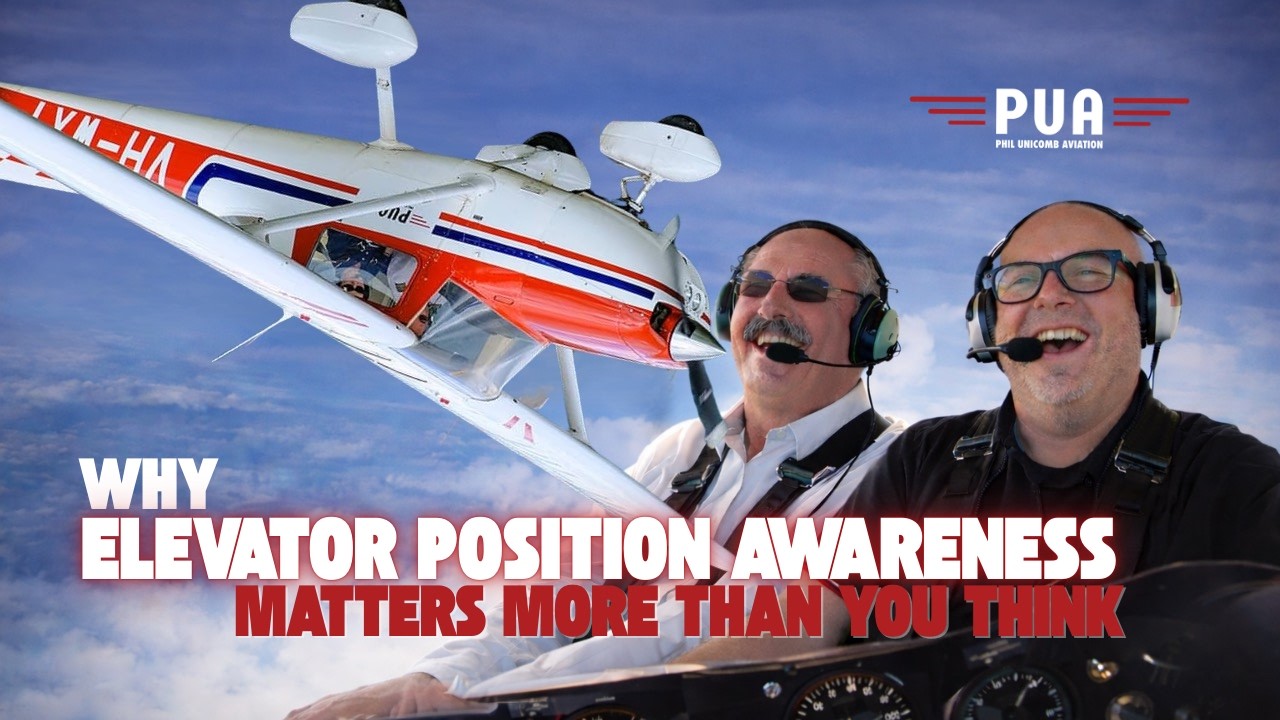
Most pilots treat the stall warning horn as the stall itself — this demonstration shows why that assumption is both wrong and potentially dangerous.
Watch full session ↗Banked Turn Stall Test Confirms: Buffet Position Does Not Shift With Power or AirspeedTo stall at a higher power setting and airspeed without climbing, a turn is used — but the bank angle itself is explicitly irrelevant to the result. What the test demonstrates is that the buffet position on the control column appears in exactly the same location as it did in stra
Stall Warning Horn Confirms Nothing: The Buffet Position Is What MattersDuring a power-off upright stall at 1g, the buffet — the physical shudder felt through the airframe — marks the precise point at which the wing reaches its critical angle of attack. This position on the control column is measurable as a distance in centimetres from neutral, and i
Flaps Are the Only Variable That Shifts the Stall Stick Position — And Even Then, Only SlightlyDeploying flaps changes the chord line of the wing, effectively creating a new aerodynamic configuration with its own fixed stall stick position. A test with 20 degrees of flap shows the position moves slightly forward compared to the clean-wing reference — but the principle is u
Stick Position Is a Distance, Not a Force — A Distinction That Changes How Pilots Train for StallsThe stall stick position is defined by how far the control column travels in centimetres, not by how hard the pilot pulls. At slower airspeeds, controls feel less firm and less effective — a sensation pilots frequently misread as evidence that the stall is occurring at a differen
Full Loop Across 360° of Pitch and 60-Knot Speed Range Produces No Stall — Until the Elevator Passes the Critical PositionStarting at 120 knots and pulling through a complete loop — descending to below 60 knots over the top — the aircraft traverses every possible pitch attitude without stalling. The stall is then triggered and released deliberately, multiple times, by moving the elevator beyond and