Accident Investigations
A curated anthology of the best moments on this topic — drawn from across the full video library, ranked by editorial relevance, with direct links to the exact timestamp in every source session.

The crash of Flight 293 was not caused by one mistake. It was the product of a day in which almost everything that could go wrong did — and no one stopped the clock.
Watch full session ↗NTSB Finds Viscous Hydroplaning Caused Flight 293 Overrun; FAA Tightens Wet-Runway StandardsThe National Transportation Safety Board attributed the accident to extreme loss of braking friction caused by viscous hydroplaning on an ungrooved, water-saturated runway. The board stopped short of finding the crew's actions causal, but concluded the accident was entirely avoid
Flight 293 Crossed Into the St. John's River at 80 Knots After Hydroplaning Through All BrakingCrossing the runway threshold at 120 feet altitude, 17 knots fast, and with a 10-knot tailwind, Flight 293 touched down 1,580 feet beyond the designated touchdown zone. The single functioning thrust reverser engaged and pulled the aircraft to the right; the auto brakes activated,
FAA Warned Airlines About Ungrooved Runway Hazards in 2015. Miami Air Never Updated Its Procedures.As Flight 293 descended toward Naval Air Station Jacksonville, rainfall was exceeding six centimetres per hour over Runway 10/28 — a surface without grooves, meaning water pooled evenly rather than draining toward the edges. The FAA had issued a safety alert as far back as 2015 w
Viscous Hydroplaning on a Thin Film of Water Made Braking on Flight 293's Runway Nearly ImpossibleThe FAA's own definition of a 'wet' runway spans an enormous range — from 25 percent surface coverage with minimal moisture all the way to 100 percent coverage with up to three millimetres of standing water — a spread so wide that it obscures meaningful differences in braking per
Crew Pressed Ahead Through Thunderstorm Over Jacksonville Despite FAA Guidance Against ItWeather radar at the time of Flight 293's approach showed a large storm cell parked directly over Jacksonville — conditions that FAA guidance explicitly identifies as requiring a hold or a divert. Wind shear, turbulence, hail, and intense rain are among the hazards that make appr
Missed Checklist Step and Failure to Call Go-Around Compounded an Already Unstable ApproachTransferred to the radar final controller for the last phase of the approach, Flight 293 was already above the normal glide path — a consequence of the late extension of high-drag devices and the tailwind pushing the aircraft forward faster than anticipated. The captain disconnec

Understanding why experienced pilots made a catastrophic navigational error starts with the airport's layout — and how well the crew thought they knew it.
Watch full session ↗'That's Weird With No Lights' — The Warning That Came Ten Seconds Too LateTen seconds into the takeoff roll, the first officer voiced a quiet unease: 'That's weird with no lights.' The comment was real — a fragment of situational awareness surfacing from beneath the expectation bias — but it arrived into a cockpit already primed to dismiss it. The NOTA
Large '26' Markings, Lit Signs, and a 40-Degree Compass Error — All IgnoredThe clues available to the crew were neither subtle nor ambiguous. The numeral '26' was painted in large characters on the runway surface directly ahead. Illuminated taxiway signs on the sides of the pavement clearly identified the runway. The aircraft's own magnetic compass read
Comair Had No Mandatory Heading Cross-Check, and the NOTAM Made the Darkness Feel NormalComair's procedures required crews to set their heading bugs to the departure runway — but stopped short of mandating an explicit cross-check that compared the bug setting against the compass before takeoff, a verification step the FAA had already recommended operators adopt. Tha
NTSB Finds Sterile Cockpit Breach and Structural ATC Flaw at Root of Comair DisasterThe National Transportation Safety Board concluded that the crew of Comair Flight 5191 failed to use the cues and verification tools available to them, and failed to confirm their runway alignment before beginning the takeoff roll. Investigators identified two contributing factor
Cockpit Voice Recorder Reveals Sterile Cockpit Rules Were Broken During Critical Taxi PhaseAs the aircraft taxied through the pre-dawn quiet of Blue Grass Airport, the cockpit voice recorder captured the two pilots engaged in relaxed conversation about pay rates, working conditions, and competitor airlines — topics with no bearing on the departure ahead. Sterile cockpi
Airport Construction Reshaped Taxiway Alpha, Making the Wrong Turn Feel Identical to the Right OneUnder pre-construction conditions, Taxiway Alpha extended beyond the Runway 26 intersection, requiring the captain to make two sequential left turns before aligning with Runway 22 — a sequence that experienced crews had absorbed as muscle memory. When construction truncated that

Fifteen years of safe commercial aviation ended in seconds over Washington D.C. — and the investigation reveals it should never have been allowed to get that close.
Watch full session ↗Blocked Radio Transmission, Inhibited TCAS, and Altimeter Error Sealed the Collision's Final SecondsAt 20:47:33, a conflict alert sounded in the DCA tower as PAT 25 and Flight 5342 closed on each other. The controller transmitted an instruction to "pass behind the CRJ," but a simultaneous transmission from inside the helicopter blocked the critical phrase; the crew heard only "
Over 4,000 Aircraft-Helicopter Proximity Events Recorded at DCA Between 2018 and 2025; Warnings Were Not Acted OnBetween January 2018 and February 2025, more than 4,000 instances were recorded in which a fixed-wing aircraft came within 1,000 feet of a helicopter in the DCA area. In 348 of those cases, the aircraft closed to within 500 feet — a rate exceeding five incidents per month. A near
NTSB Blames FAA for Placing Helicopter Route Near Active Approach Path and Ignoring Known Collision RiskThe NTSB's final report — 419 pages, 74 findings, and 57 recommendations, produced in just over a year — identified the probable cause as the FAA's decision to permit a helicopter route in close proximity to an active instrument approach path, combined with an institutional failu
Mid-Air Collision Over the Potomac Ends 15 Years of U.S. Commercial Aviation SafetyA military helicopter and a regional airliner collided above the Potomac River on January 29, 2025, killing all 67 people aboard both aircraft and ending more than 15 years without a fatal commercial aviation accident in the United States. The collision was not a sudden, unforese
Helicopter's Altimeters Under-Read by Up to 100 Feet, Placing It Silently in the Approach PathThe UH-60L helicopter involved in the collision carried barometric altimeters that systematically indicated a lower altitude than the aircraft actually occupied — a discrepancy of up to 80 feet under normal conditions, and up to 100 feet when external fuel tanks were fitted. The
Radio Interference Stripped the Word 'Circling' From a Critical ATC Warning to the Helicopter CrewAs PAT 25 reached its 200-foot transition altitude and entered Route 4, the local controller transmitted a traffic advisory identifying a CRJ at 1,200 feet circling for runway 33. The word "circling" — the detail that would have directed the instructor pilot to scan a different p
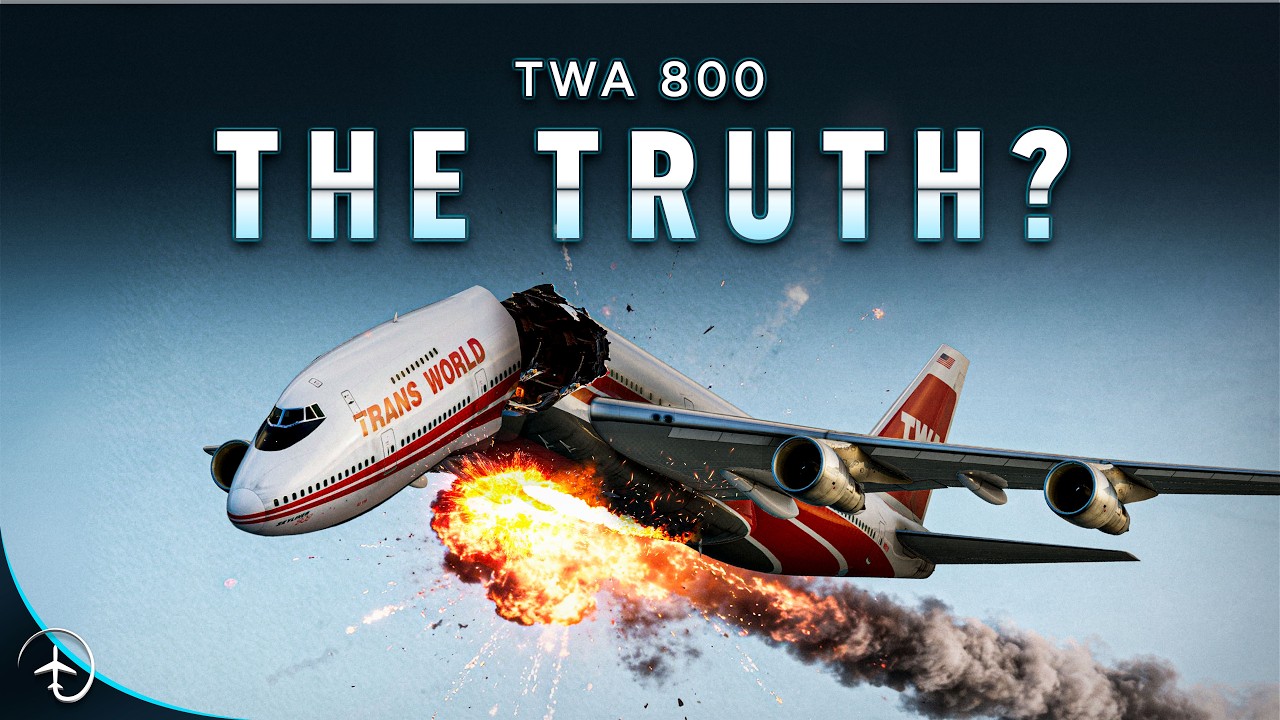
The image that convinced hundreds of eyewitnesses they had seen a missile attack was actually the burning, noseless fuselage of the aircraft itself, climbing on its own momentum. Understanding the physics resolves one of aviation's most persistent conspiracy theories.
Watch full session ↗Burning Tailless Fuselage, Not a Missile, Fooled Hundreds of TWA 800 WitnessesWhen the nose section of TWA Flight 800 separated, the loss of pitch balance caused the remaining fuselage to rear upward violently, climbing a further 2,000 to 3,000 feet on residual momentum and engine thrust before stalling at nearly 16,000 feet, rolling right, and plunging ve
TWA Flight 800 Broke Apart in Three to Five Seconds After Fuel Tank IgnitionAt 20:31:12 on the evening of 17 July 1996, a single electrical arc ignited the fuel-air mixture inside the centre wing tank of TWA Flight 800, triggering a deflagration — a rapidly propagating flame front rather than an instantaneous detonation — that nevertheless generated over
Forensic Reconstruction of TWA 800 Wreckage Ruled Out Missile or Bomb with Physical CertaintyWhen investigators reassembled the recovered wreckage of TWA Flight 800, the physical evidence told a consistent and one-directional story. Metal skin had peeled outward from the centre wing tank, structural members bore witness marks from internal collision forces, and soot depo
Silver Sulfide Deposits on Ageing Wiring Identified as the Likely Ignition Trigger in TWA 800 DisasterInvestigators identified the probable final link in the causal chain as silver sulfide contamination on the Fuel Quantity Indicating System (FQIS) wiring inside the centre wing tank. When the silver-plated copper conductors used throughout the aircraft's electrical systems were e
Air Conditioning Packs Heated TWA 800's Centre Tank to the Flammable Range Before TakeoffThe two air conditioning packs aboard TWA Flight 800, running continuously on the ground at JFK to cool the cabin on a warm July evening, were positioned almost directly beneath the centre wing tank with minimal thermal insulation separating them from the tank's lower surface. Th
Post-Accident Inspections Found Arcing Wires and Metal Shavings in Aircraft Across the FleetFollowing the TWA 800 investigation, inspectors examined airliners of various types and ages and found that serious wiring degradation was effectively universal. Metal shavings left during maintenance procedures had settled inside wiring conduits, insulation was commonly damaged,