Original source: Mentour Pilot
This video from Mentour Pilot covered a lot of ground. 6 segments stood out as worth your time. Everything below links directly to the timestamp in the original video.
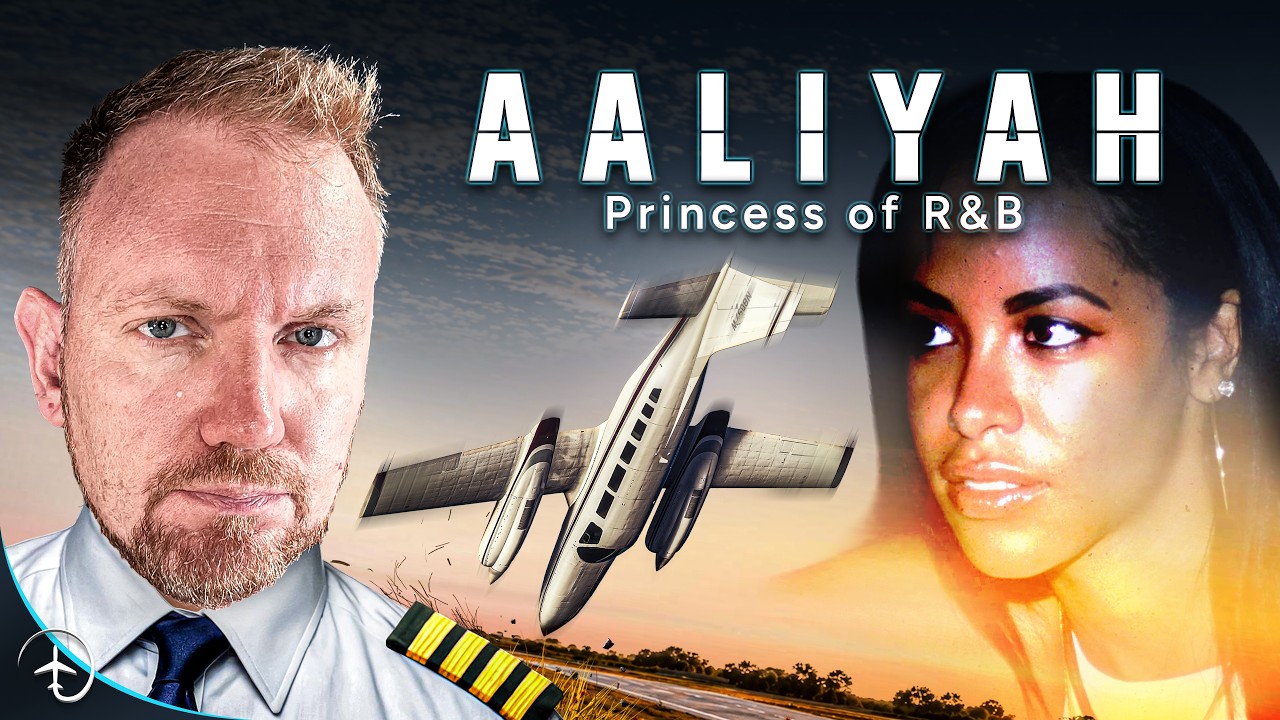
A last-minute charter swap that seemed routine on paper placed a group of nine people on an aircraft that was fundamentally less capable of handling their load — and the companies involved shared a home address.
Charter Swap Placed Aaliyah's Flight on a Smaller, Riskier Aircraft Through Opaque Corporate Arrangements
A last-minute change in charter arrangements replaced the originally planned Cessna 404 with a Cessna 402B operated by Blackhawk International Airways — an aircraft whose maximum takeoff weight was roughly 700 kilograms lower. Investigators found that Blackhawk and the aircraft's registered owner, Skystream Incorporated, shared the same home address in Pembroke Pines, Florida, suggesting the two entities were effectively the same operation wearing different corporate masks.
What makes this significant is that the switch was not merely an administrative inconvenience — it materially reduced the aircraft's capacity at exactly the moment the production team was carrying heavy film equipment alongside its passengers. The corporate opacity made it harder to assign clear regulatory responsibility when things went wrong.
Pilot at the Controls of Aaliyah's Fatal Flight Was Not Legally Authorised to Operate the Aircraft
The pilot placed in command of the Cessna 402B had been hired only days before the August 25 flight, and crucially did not hold the specific authorisation required to operate that aircraft commercially. Under the arrangement governing the plane's use, only the owner of Blackhawk International Airways was approved to fly it — yet he remained in Florida while an unqualified substitute took his place at the controls.
The finding exposed a fundamental breakdown in the oversight chain that charter operators are legally required to maintain. The question of who bore responsibility for verifying the pilot's credentials — the broker, the operator, or the aircraft owner — would become central to the investigation.
Pilot's Logbook Showed Hundreds of Flight Hours Added in a Single Update, Raising Falsification Concerns
When investigators examined the pilot's flight records, they found that a single logbook entry made eight months before the crash had simultaneously added hundreds of hours across multiple categories — including 81 night landings, 79 hours of pilot-in-command time, 212 hours of solo flight, and 67 additional hours in a further category. In a legitimately maintained logbook, experience of that breadth accumulates gradually; its sudden appearance in one sitting pointed strongly toward fabrication.
Each category investigators flagged serves a distinct safety purpose: night landings measure precision, cross-country hours reflect navigation competence, and pilot-in-command time reflects decision-making under sole responsibility. Inflating all of them at once understated the pilot's true inexperience on exactly the metrics operators rely upon to gatekeep complex commercial flights.
Pilot's Cocaine Conviction and Falsified Records Would Have Been Caught by Post-9/11 Security Checks
The investigation established that the pilot had been convicted on a felony cocaine possession charge only weeks before being hired by Blackhawk International Airways — a disqualifying criminal record that more rigorous background screening would have surfaced. Investigators noted that had the music video shoot taken place a month later, post-September 11 security reforms would likely have uncovered both the conviction and the logbook irregularities before he ever boarded the aircraft. Witness accounts also described baggage and film equipment being loaded haphazardly, with no evidence the pilot asserted command authority to slow or reorganise the process despite clear signs the load was unmanageable.
The failure here was not one of individual recklessness alone. It was systemic: the hiring framework, the background check regime, and the pre-departure loading culture all failed simultaneously.
Cessna Departed 410 Kilograms Over Maximum Weight With Centre of Gravity 11 Centimetres Beyond Safe Limit
Post-crash reconstruction of the aircraft's loading revealed that the Cessna 402B lifted off from Marsh Harbour carrying more than 410 kilograms above its certified maximum takeoff weight, with nine occupants aboard — one beyond its passenger limit — including two crew members each weighing approximately 135 kilograms seated at the rear. No weight-and-balance calculation was ever completed. The result was a centre of gravity positioned 11 centimetres aft of the maximum allowable limit, a displacement that, on a compact twin like the Cessna 402, fundamentally altered the aircraft's pitch behaviour.
With the centre of gravity that far rearward, the elevators lost the mechanical leverage needed to push the nose down and reduce the angle of attack — meaning a pitch-up excursion during takeoff would be not just likely but nearly unrecoverable from the moment the wheels left the ground.
Toxicology Found Alcohol and Cocaine in Pilot's System as Overloaded Cessna Stalled and Killed All Nine on Board
Toxicology testing confirmed the presence of both alcohol and cocaine in the pilot's system at the time of the crash. While investigators could not determine the precise degree of impairment, both substances were independently disqualifying under any aviation standard. Witnesses described the engines backfiring during taxi, the aircraft requiring an abnormally long takeoff roll, and the nose pitching up to a steep and unrecoverable angle almost immediately after lift-off. With the centre of gravity pushed far aft, pitch control was effectively lost; the aircraft entered a fully developed stall at low altitude and struck the ground seconds later. Six occupants died on impact, including Aaliyah; the remaining three died before emergency responders could intervene, bringing the total to nine.
This was not a single failure — it was a chain of events in which falsified credentials, an unauthorised pilot, corporate opacity, haphazard loading, and impairment converged into an accident that was, at every stage, preventable.
Summarised from Mentour Pilot · 30:26. All credit belongs to the original creators. Streamed.News summarises publicly available video content.