Original source: Mentour Pilot
This video from Mentour Pilot covered a lot of ground. 17 segments stood out as worth your time. Everything below links directly to the timestamp in the original video.
A routine radio exchange that took seconds to complete would take 160 lives — and the misunderstanding was never caught by either side.
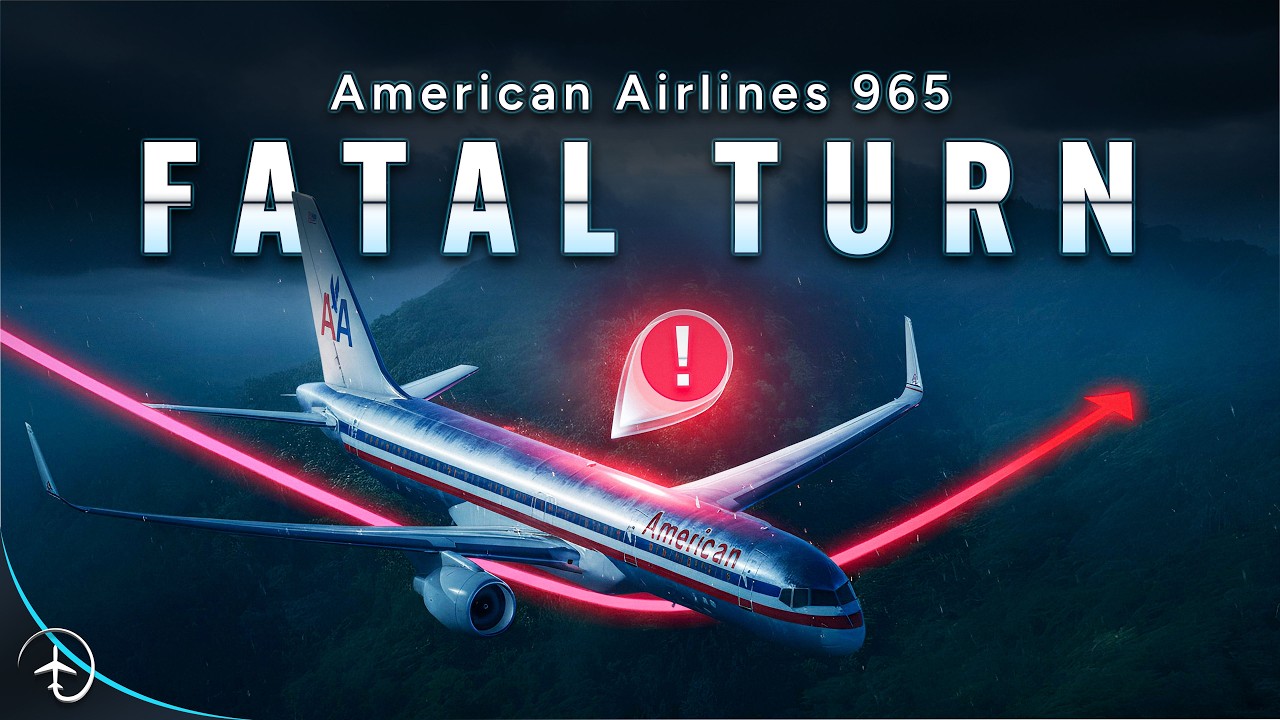
A Misread ATC Clearance Sets American Airlines Flight 965 on a Fatal Path
The chain of errors that destroyed American Airlines Flight 965 near Cali, Colombia, began with a single misread radio clearance. When the Cali approach controller cleared the crew to proceed via the ROZO 1 Standard Terminal Arrival Route — instructing them to report passing the TULUA VOR — the captain read back "direct to Cali VOR," stripping the arrival's intermediate waypoints from his mental model of the route before the aircraft had even begun its descent.
What makes this particularly significant is not the error itself but its invisibility. The controller did not catch the discrepancy in the readback, and the crew did not recognise the misunderstanding. That single moment of crossed communication would quietly corrupt every decision that followed.
"Clear direct to Cali VOR, report TULUA, altitude one five."
Habit and Expectation Bias Led Captain to Misinterpret Non-Radar Clearance Over Colombian Andes
The captain's misreading of the Cali clearance was not random error — it reflected a deeply ingrained cognitive pattern. In the radar-controlled airspace of the United States, a controller clearing a flight "direct" to a fix routinely means exactly that: fly straight there from the present position. In non-radar airspace like Cali, where controllers track aircraft only by position reports along prescribed routes, issuing such a clearance over mountainous terrain would be operationally reckless — and therefore almost never done.
The captain had received training on Latin American procedures and had flown the route before, yet his brain filtered the ambiguous clearance through a familiar template rather than the one that applied. This is a textbook instance of expectation bias: the mind completes a pattern it recognises, even when the context demands something different.
Flight 965's FMS 'Direct-To' Command Silently Erased the Waypoints That Could Have Saved the Aircraft
When the captain entered a direct routing to the Cali VOR into the Boeing 757's Flight Management System, the CDU — a small keyboard-and-screen unit near the pilots' knees — instantly and silently deleted every intermediate waypoint from the active flight plan. TULUA and ROZO, the two navigational fixes that structured the ROZO 1 arrival procedure through the Andes, vanished from the navigation display. The 1995-era FMS used a primitive form of GPS with no terrain overlay; the screen showed only a magenta routing line on a black background, giving no visual cue that critical waypoints had been removed.
The design reflected the automation philosophy of its era: efficient and powerful, but unforgiving of unchecked inputs. A single keystroke had restructured the crew's entire navigational picture without any warning.
A Four-Second Runway Change Decision Confronted Flight 965's Crew with an Impossible Geometry
At 21:36, the Cali approach controller offered the crew a straight-in approach to Runway 19 — a shortcut that could save several minutes of flying. The crew agreed in approximately four seconds. What that acceptance actually required was a steep, continuous descent from above 20,000 feet to 5,000 feet within 21 nautical miles, using a non-precision VOR/DME approach the crew had not briefed, for a runway that was not in their programmed flight plan, in mountainous terrain at night. Standard procedure demanded a full approach briefing, chart review, recalculation of speeds and descent profiles, and coordination of missed-approach contingencies — none of which had been completed.
The offer was operationally attractive precisely because it appeared to solve multiple pressures at once: lighter traffic, cabin crew rest-time limits, and schedule recovery. That convergence of incentives made a decision that was deeply unsafe feel, in the moment, entirely routine.
"Yeah, we'll have to scramble to get down."
Routine Habit, Time Pressure, and Workload Underestimation Combined to Produce a Fatal Acceptance
The decision to accept the Runway 19 shortcut was the product of several reinforcing factors, none decisive on its own. Crews in radar-controlled domestic airspace routinely accept late runway changes with little penalty; it had become a normalised response. The offer was also unusual in non-radar airspace, which may have made it feel like a rare opportunity rather than a warning sign. On top of this, cabin crew rest-time limits had created a latent scheduling pressure that made any time-saving attractive. And because workload had been low up to that point, the crew likely underestimated how sharply the complexity of an unbriefed approach would drive it upward.
The cumulative lesson is one that applies broadly to high-stakes decision-making: the moments when multiple pressures simultaneously point toward the same choice are precisely the moments that deserve the most scrutiny, not the least.
Speed Brakes Deployed and TULUA Confusion Deepened as Flight 965 Began Its Descent Toward the Andes
With the Runway 19 approach accepted, the first officer increased the descent rate and deployed the speed brakes — a device that reduces lift and increases drag — without calling out the action. No one acknowledged it. The captain requested a lower altitude, and the controller cleared the crew all the way down, effectively handing off vertical responsibility. He also repeated, twice, the requirement to report passing TULUA. The captain heard this as a surprise: TULUA had already been deleted from his navigation display, so the instruction made no sense within his current mental model of the route.
This was the first moment the two realities — what the controller believed the crew was doing and what the crew actually understood — became openly visible, yet neither side fully grasped the gap between them.
"I got to give you TULUA first of all."
Chart Search and ROZO Confusion Compounded Flight 965's Navigational Breakdown
When the controller's repeated TULUA instructions registered, the captain reached for his approach charts — a task that consumed attention at the exact moment the crew most needed to be absorbing the structure of the approach ahead. The first officer, who had not briefed the ROZO 1 arrival, lacked a clear spatial picture of how TULUA and ROZO related to each other, partly because the procedure was named after an intermediate fix rather than its starting point. After roughly a minute of searching, the captain located the chart, then made a request that revealed how deeply his mental model had drifted: he asked the controller for a direct clearance to ROZO before flying the ROZO 1 arrival — a route that, by definition, begins at TULUA.
The request was internally contradictory, and the controller could not find the English words to explain why.
"Can American 965 go direct to ROZO and then do the ROZO arrival?"
Language Barrier Prevented Controller from Correcting a Logically Impossible Routing Request
Faced with a request he could not parse — fly to the end of a procedure before starting it — the Cali controller lacked both the English vocabulary and the time to explain the contradiction. He repeated the original clearance: fly the ROZO 1 arrival to Runway 19, report TULUA, cross the 21-nautical-mile fix at 5,000 feet. The captain read it back, but the underlying confusion remained intact. He appeared to still believe that ROZO was the procedure's entry point rather than its final beacon before the runway, meaning successive repetitions of correct instructions were landing on an entirely wrong mental framework.
The episode illustrates a structural risk in international aviation: when a crew's model of a situation is fundamentally incorrect, accurate clearances can reinforce the error rather than correct it.
A Database Identifier Collision Sent Flight 965 Toward the Wrong Beacon — 132 Miles Away
When the captain typed the single-letter identifier for the ROZO non-directional beacon into the CDU, the FMS returned a different beacon entirely: ROMEO, located near Bogotá, 132 nautical miles away. The collision existed because both beacons shared the identifier 'R' and operated on the same frequency, 274 kilohertz. Jeppesen, the chart publisher, had resolved the conflict by storing ROZO under its full spelled-out name in the database — but this was an edge case the captain had never encountered, since previous flights to Cali had always used pre-programmed route packages where ROZO was already embedded. Under the high workload of an unbriefed approach, he typed 'R', instinctively selected the first result from the drop-down list, and pressed execute.
The autopilot then began turning the aircraft more than 90 degrees to the left — toward the mountains east of Cali — and neither pilot noticed.
Autopilot Executed a 90-Degree Wrong Turn While Both Pilots Were Looking Elsewhere
As the aircraft swung sharply left toward terrain, the captain was tuning a VHF navigation radio and the first officer was reviewing approach charts. Neither was monitoring the autopilot's behaviour on the navigation display — a failure that is comprehensible only in the context of the workload both men were carrying. In less than two minutes the crew had accepted an unbriefed approach, been surprised by a waypoint requirement that contradicted their FMS, searched for charts, and attempted to reprogram the system — tasks that crowded out the monitoring function entirely.
The investigation would later confirm what human-factors research consistently finds: when cognitive load increases sharply, monitoring tasks are the first to be shed. Active tasks — typing, tuning, reading — hold attention. Passive surveillance — checking whether the autopilot is doing the right thing — does not.
First Officer's 'Where Are We Going?' Went Unanswered as Flight 965 Turned Toward High Terrain
As the aircraft continued its left turn, the first officer twice asked the captain where they were heading — a question that, in its plainness, signals a complete loss of navigational orientation. The captain's responses were evasive and exploratory rather than commanding: he suggested coming right a little, possibly recognising that the turn triggered by his ROZO input had been a mistake. At this moment the aircraft was tracking almost due east, directly toward the high ridges of the Colombian Andes, and descending through speed brakes that were still deployed.
The controller also sensed something was wrong and asked for their distance, but received only a routine response. No one in the cockpit or the control room yet understood the full geometry of what was unfolding.
"Where are we going out to?"
Flight 965 Crew Were Already Past TULUA While Still Trying to Navigate Toward It
The captain's decision to enter TULUA directly into the FMS produced a navigation display showing a left turn — a result that baffled him because, in his mental model, TULUA should still lie ahead. The display was correct: the aircraft had already overflown the beacon and it now lay behind them. But rather than triggering a recognition that the situation had fundamentally changed, the contradiction deepened the confusion. The captain began identifying the TULUA VOR by its Morse-coded radio beacon to confirm he had the right frequency, then insisted on pressing toward it despite the visual evidence on the display pointing the opposite direction.
This was not irrationality — it was a mind defending a model that had long since ceased to match reality.
"No, hell no! Let's press on to… TULUA."
FMS Fixation and Attention Tunneling Blinded Flight 965 Crew to the Mountains Below
By the time Flight 965 was descending through the Andes at more than 2,000 feet per minute with speed brakes still extended, both pilots were absorbed in resolving a navigational debate about TULUA — heads down, arguing with the FMS and with each other, rather than flying the aircraft. The correct response, as American Airlines training captain Warren Vanderburgh later framed it, was not to reprogram the computer but to put down the keyboard, climb to the minimum safe altitude, and reorient from a position of safety. Instead, the crew was debating whether the FMS was correctly representing TULUA's position.
This was not a failure of intelligence or skill. It was a failure of priority sequencing under stress — the classic inversion of 'aviate, navigate, communicate' in which the navigation task consumed the attention that should have been devoted to simply flying the aircraft away from the ground.
Authority Gradient and Unfamiliar Terrain Silenced the One Voice That Might Have Broken the Chain
The cockpit voice recorder transcript suggests the first officer sensed something was wrong and felt the pull toward saying so — toward demanding a missed approach and a climb. He did not. The investigation concluded that while he was normally an assertive crew member, he had become functionally dependent on the captain to navigate a complex, unfamiliar airport in a country he had never flown into before. That dependency likely suppressed the assertiveness that crew resource management training is specifically designed to preserve. Meanwhile, the captain's own attempt to correct the situation — turning right and trying again to enter TULUA — was itself another iteration of the same FMS-dependent thinking that had produced the original error. Turning right did re-establish the correct heading toward Cali, but by then the aircraft had crossed east over the Andes and now needed to cross back over them while still descending.
"We got suckered up here, didn't we?"
Controller's Final Altitude Check Went Unanswered as Flight 965 Flew Into the Andes
In the final minutes, the captain cycled through the same TULUA-then-ROZO loop he had been running for several minutes, with the FMS refusing to accept TULUA because the beacon was now behind the aircraft. The first officer, simultaneously adjusting the altimeter for the transition to local pressure as the aircraft descended toward the airport environment, was occupied with a separate procedural task. In the control tower, the controller had grown uneasy enough to try a diagnostic: he asked for the crew's altitude and then their distance from Cali, hoping to check whether the two numbers were compatible with a safe approach. He never received the second answer. Seconds later, the ground proximity warning system activated.
Forgotten Speed Brakes Robbed Flight 965 of the Climb Performance That Might Have Cleared the Ridge
At 21:41:15, the ground proximity warning system triggered its automated 'Terrain, terrain, pull up' alert. Both pilots reacted immediately, the first officer hauling back on the control column while the captain advanced the thrust levers to maximum. But the speed brakes — deployed quietly nearly six minutes earlier, never called out, never retracted — remained extended throughout, imposing a severe aerodynamic penalty on the aircraft's climb rate precisely when every foot per minute of performance was critical. Retracting the speed brakes was not included in the Boeing 757's terrain escape memory items at the time: those items required maximum pitch and maximum thrust, held until clear of terrain, but said nothing about drag devices.
This was not a single failure — it was a chain of events. The speed brakes had been the last surviving link, invisible throughout the descent, finally fatal on the climb.
"Pull up, baby! More, more!"
Flight 965 Crash Killed 160 of 163 on Board and Reshaped Global Aviation Safety Standards
American Airlines Flight 965 struck the Andes on the night of December 20, 1995, killing 160 of the 163 people on board. Four passengers and a dog survived. The accident became a landmark case in aviation safety education, used worldwide to teach situational awareness, crew resource management, and the dangers of automation dependency. Within a few years the Federal Aviation Administration mandated the enhanced ground proximity warning system — then still developmental — on all transport aircraft, a technology that would have given the crew of Flight 965 more than three times the warning time the older system provided. The crash also directly produced a new memory item for terrain escape manoeuvres: retract the speed brakes the instant the warning sounds.
What the accident most clearly demonstrates is that cognitive traps do not discriminate by experience level. These were accomplished pilots who flew a technically serviceable aircraft into a mountain because they fell progressively behind it — a reminder that safety systems, procedures, and training must be built for the minds that actually operate under pressure, not the idealised versions.
Summarised from Mentour Pilot · 53:42. All credit belongs to the original creators. Streamed.News summarises publicly available video content.