Original source: Mentour Pilot
This video from Mentour Pilot covered a lot of ground. 10 segments stood out as worth your time. Everything below links directly to the timestamp in the original video.
A one-digit arithmetic error nearly brought down a fully loaded Boeing 777. Understanding how it happened matters for every passenger who assumes pre-flight checks catch everything.
LATAM Boeing 777 Took Off at Milan With 100,000 kg More Than Pilots Calculated
A LATAM Airlines Brazil Boeing 777 departed Milan Malpensa Airport on July 9, 2024, carrying roughly 100,000 kilograms more than its crew had calculated — a discrepancy equivalent to the weight of 17 adult male African elephants. The error originated in a single dropped digit during pre-flight weight entry and cascaded through every subsequent performance calculation before the aircraft ever moved.
The incident illustrates how a routine data-entry mistake, amplified by time pressure and deference to authority, can push a heavily loaded wide-body jet to the edge of catastrophe before anyone in the cockpit realises something is wrong.
LATAM Brazil Boeing 777 Incident Began With Routine Departure From Milan Malpensa
On July 9, 2024, a LATAM Airlines Brazil crew prepared to operate a long-haul flight from Milan Malpensa Airport to São Paulo aboard a Boeing 777-300 — one of ten wide-body jets in the carrier's 170-aircraft fleet. Nothing in the pre-departure routine initially suggested the flight was anything other than ordinary.
The apparent normality of those early preparations is precisely what makes the incident instructive: the conditions for a near-catastrophic error were assembling quietly, invisibly, well before the aircraft left the gate.
Loadsheet Handoff Process Planted the Seeds of a Critical Weight Error
The relief captain received the flight's loadsheet on his smartphone and forwarded it to his iPad, but the trainee captain had not yet received his own copy. The relief captain therefore dictated the key figures aloud — a zero fuel weight of 219,460 kilograms and a takeoff gross weight of 328,425 kilograms — while the trainee captain entered them into the flight management computer. That weight would determine every subsequent performance figure: thrust setting, flap angle, and the critical V-speeds at which the aircraft would be declared committed to flight and then rotated.
The reliance on verbal dictation rather than independent document review created a single point of failure at the most consequential moment of the pre-flight process.
Time Pressure and a Forgotten Figure Set Up the Fatal Calculation Error
While working through the performance calculations, the trainee captain entered the zero fuel weight into the flight management computer and noted a gross weight figure — but was interrupted almost immediately when Malpensa ground control announced the crew was second in line for pushback and that their slot time was imminent. Seconds later, he had forgotten the gross weight the computer had displayed. Pressed for time, he turned to the training captain for the figure rather than navigating back through the computer himself.
What makes this particularly significant is that the interruption did not feel dangerous in the moment — it felt like ordinary operational urgency, the kind that experienced crews manage every day. That normalcy is precisely what made it so effective at eroding the independent verification the procedure required.
Dropped Digit in Weight Entry Left Boeing 777 100,000 kg Heavier Than Calculated
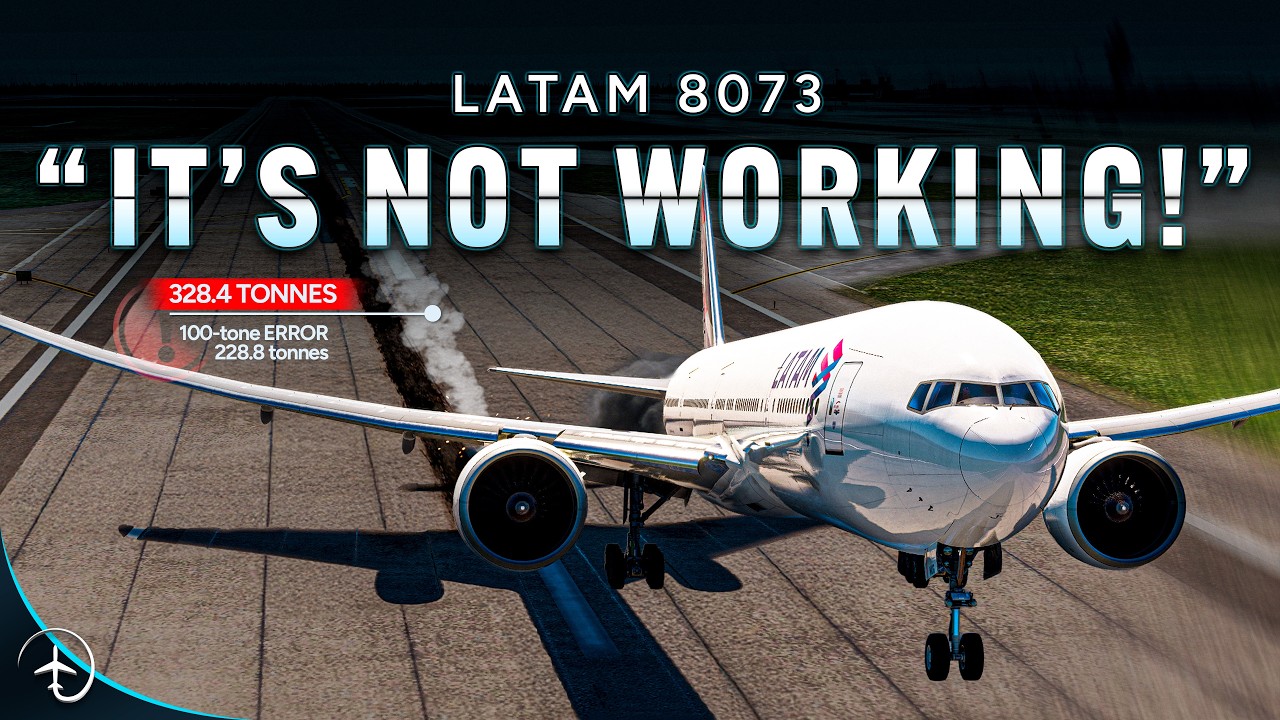
When the training captain looked up the takeoff weight, he most likely dropped a digit in the hundreds column, entering 228.8 metric tons into the performance tool instead of the correct 328 tons. The trainee captain, on only his tenth flight on the Boeing 777 and working under an instructor he trusted, accepted the figure rather than computing it independently — meaning both iPads now carried the same wrong number. The resulting performance data assumed an aircraft 100,000 kilograms lighter than the one sitting on the apron.
The investigation would later note that 228 tons is a plausible takeoff weight for a Boeing 787-9, a type the training captain also flew, which may explain why the figure raised no instinctive alarm. Authority gradient — the tendency of junior crew members to defer to seniors — then suppressed the independent cross-check that procedure explicitly required.
Underweight Calculation Produced V-Speeds 30 Knots Too Low — and a Warning No Pilot Recognised
The 100,000-kilogram shortfall in the entered weight caused the performance tool to select an assumed temperature of 56°C for thrust deration and a flap setting of five degrees — the lowest available — producing V-speeds of 145 knots for V1, 149 for rotation, and 156 for V2, each approximately 30 knots below what the aircraft's actual weight demanded. When the pilots entered these speeds into the flight management computer, the system displayed a message reading 'V-speeds unavailable' — a warning that existed precisely because the selected thrust and flap combination was physically insufficient for the runway length at the aircraft's real weight. None of the three pilots had seen the message before, and none consulted the flight crew operating manual, which stated clearly that a takeoff was not permitted when it appeared.
What the investigation would later reveal is that a chain of safety nets — independent calculation, cross-checking against reference speeds, and a software prohibition on entering anomalously low V-speeds — had all been bypassed, leaving a cryptic one-line warning as the last barrier between the crew and disaster.
Milan Incident Echoes a Pattern of Weight-Entry Errors Across Multiple Aircraft Types
Entering an incorrect takeoff weight is not a novel failure mode. In 2004, an MK Airlines Boeing 747 crashed after a crew member populated the takeoff weight field with data from a previous sector on which the aircraft had been empty. In 2009, an Emirates Airbus A340 overran the runway and struck the localizer antenna after pilots entered a weight that was substantially too low, though the aircraft eventually became airborne. In a third incident, a Boeing 777 freighter crew at Paris Charles de Gaulle again dropped a digit in the weight field, nearly causing a tail strike before clearing the runway threshold.
The recurrence across different airlines, aircraft types, and continents points to something systemic — a fundamental vulnerability in how performance data is entered, verified, and acted upon — rather than isolated lapses by individual crews.
LATAM Flight 8073 Dragged Its Tail for 723 Metres Before a Relief Captain's Shout Saved It
Cleared for takeoff at 13:25, the crew advanced the thrust levers to a setting limited by the erroneously selected assumed temperature, and the engines spooled to just 92.8 percent N1. Thirty-five seconds into the roll, the automated voice called V1 at 145 knots — 30 knots below the speed the aircraft's actual weight required. At 149 knots the training captain rotated, but the main landing gear stayed on the ground; the wings could not generate enough lift. As the tail descended toward the runway surface, the aircraft's own protection system tried to push the nose down, but the strike was unavoidable. Metal fragments scattered across the asphalt as the tail skid gouged 723 metres of runway. The training captain, frozen in what the investigation describes as a startle response, exclaimed that something was wrong but did not act — until the relief captain, watching from the jump seat, shouted 'TO/GA' twice. On the second call, the training captain pushed both levers to maximum thrust, the engines overcame the drag, and the aircraft finally climbed away.
The relief captain's intervention was the decisive factor in what was, by that point, a rapidly narrowing window of survivability. His ability to cut through the cockpit confusion with a single, unambiguous command — rather than a question or an observation — exemplifies what crew resource management training exists to produce.
"TO/GA!"
Crew Followed Abnormal Procedures, Dumped Fuel, and Returned Safely to Milan
Once airborne, the aircraft's Engine Indication and Crew Alerting System triggered a continuous chime and a tail strike warning, while the flight data recorder captured a loss of pressure in both APU fire extinguisher bottles — damage consistent with the severity of the strike. The training captain relinquished control to the relief captain, who levelled off at 6,000 feet, and the crew followed abnormal checklists that prohibited pressurisation. Because the aircraft was carrying full fuel for the São Paulo sector, it was far above its maximum landing weight, so the crew flew southwest of Milan over a rural area and jettisoned fuel until the weight was acceptable. The aircraft then returned to Malpensa and landed on Runway 35 Right at 14:36, without further incident.
The orderly handling of the emergency — the clear division of duties, the methodical use of checklists, and the decision to dump fuel rather than impose an overweight landing on already-stressed structures — stood in stark contrast to the confused minutes on the runway, and demonstrated that the crew's training ultimately held.
Italy's Air Safety Agency Calls for Software Fixes; EASA Sets 2025 Deadline for New Aircraft
Italy's National Flight Safety Agency, ANSV, concluded that LATAM Airlines' own procedures contained ambiguities — including a failure to mandate explicit cross-checks during performance tool entry — that increased the likelihood of exactly the kind of error the Milan crew made. The ANSV's central recommendation was that adding yet more manual checks to an already complex pre-flight sequence would likely be counterproductive under time pressure, and that the more durable fix lies in flight management system software capable of automatically detecting gross weight-entry errors. The European Union Aviation Safety Agency has since mandated that all newly manufactured large aircraft must carry a takeoff performance monitoring system from 2025, with existing types required to follow by 2033 — though the regulation does not extend to aircraft already in service, a gap that concerns safety analysts.
LATAM Airlines has updated its procedures to remove the identified ambiguities and improved its flight data monitoring programme to flag takeoff performance anomalies. The broader lesson, however, is that procedural revisions alone have repeatedly failed to prevent this class of error across the industry — and that the Milan incident may finally be accelerating the technological solution.
Summarised from Mentour Pilot · 44:05. All credit belongs to the original creators. Streamed.News summarises publicly available video content.