Original source: Mentour Pilot
This video from Mentour Pilot covered a lot of ground. 12 segments stood out as worth your time. Everything below links directly to the timestamp in the original video.
The crew knew bad weather was possible — they just had no idea how bad it had already become. Understanding why reveals a systemic vulnerability that long predated the digital age.
Flight 242 Crew Had Hours-Old Warnings as 20 Tornadoes Touched Down on Their Route
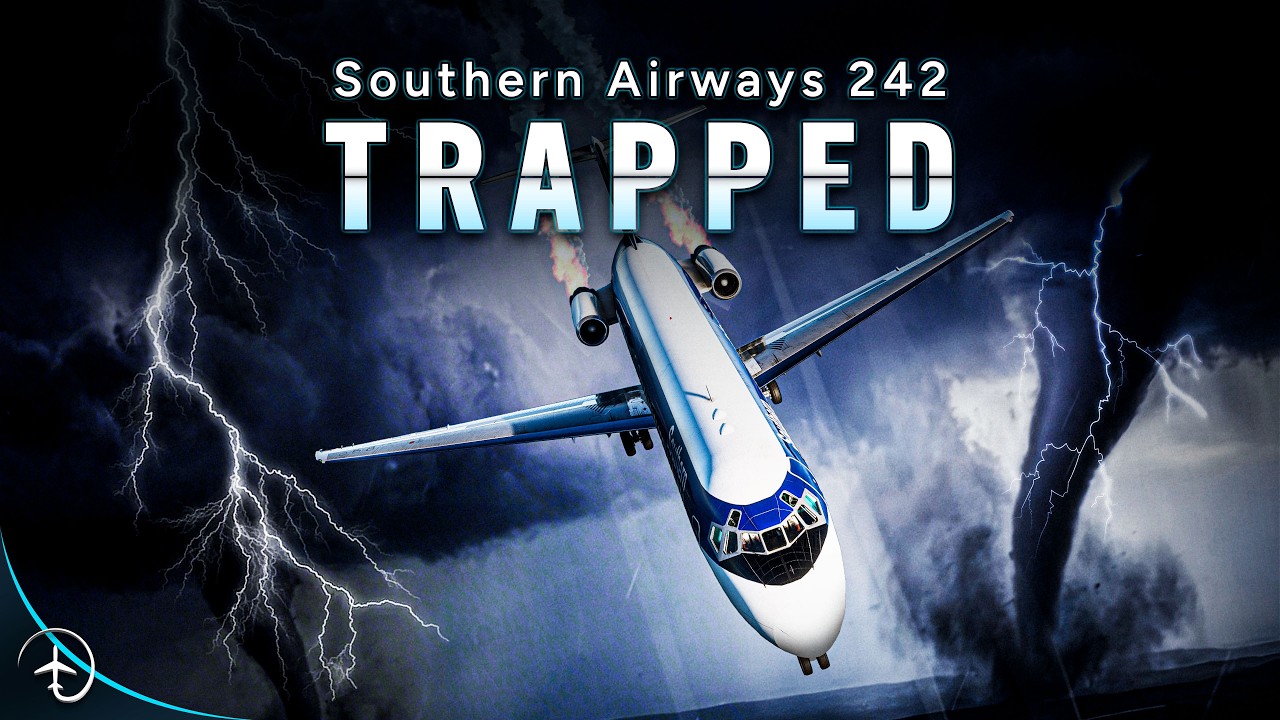
When Southern Airways Flight 242 departed in April 1977, the National Weather Service had already issued tornado watches and SIGMETs nearly three hours earlier, and the crew's paperwork acknowledged the threat. Yet 20 tornadoes had touched down across Alabama and Georgia, including one directly on the planned flight path, before the aircraft even left Muscle Shoals. The warnings existed on paper, but without real-time weather data — the airline had not subscribed to the RAWARC system, and a broken fax machine blocked access to the Weather Bureau's radar product — those warnings carried little operational weight.
What makes this particularly significant is that it was not ignorance but a fractured information chain that left the crew flying blind. In 1977, getting live weather into a cockpit depended on every link in that chain — broadcaster, airline, dispatcher, crew — functioning simultaneously. A single broken fax machine was enough to sever it.
"Warnings on paper don't have the same effect as a real-time weather map."
Broken Fax Machine and Unsubscribed Warning Service Left Southern Airways Crew Without Real-Time Radar
Southern Airways had not subscribed to the RAWARC real-time weather alert system, and on the day of the accident, the fax machine at the Huntsville station that received the Weather Bureau's radar printouts was out of service. Nine minutes before departure, a dispatcher called the National Weather Service office in Athens, Georgia, for updated information — but the line was busy. The crew departed equipped only with airport weather observations and SIGMETs that were several hours old, wholly inadequate for a storm system that was intensifying by the minute.
This was not a single failure — it was a chain of organisational and infrastructural deficiencies that each independently would have been recoverable, but together ensured the flight crew had no accurate picture of what lay ahead.
Flight 242's Weather Radar Could Not Distinguish Storm Cores from Clear Air, Investigation Found
The DC-9 operated by Southern Airways carried a Bendix RDR-1E weather radar, a black-and-white display that showed precipitation as white static and required pilots to switch to a special contour mode to gauge storm intensity. In that mode, the most severe precipitation appeared as a dark hole surrounded by white — but so did clear air, making the two visually indistinguishable at a glance. Compounding this, the radar operated in the X-band frequency range, which made it vulnerable to attenuation: when the aircraft was already inside or near heavy precipitation, the radar signal was absorbed before reaching deeper storm cells, causing those areas to appear falsely clear.
The investigation would later establish that as Flight 242 pressed through cloud and rain, its radar picture was almost certainly being distorted in precisely this way at the moment the crew needed reliable guidance most.
CVR Captures Flight 242 Crew's Rapid Descent from Concern to Full Storm Immersion
At 15:57, the controller handling Flight 242 told the crew they appeared to be passing through the heaviest part of the weather, a remark the pilots interpreted as reassurance rather than warning. The cockpit voice recorder captured the captain expressing cautious optimism — 'as long as it doesn't get any worse' — while the first officer searched the radar for a navigable gap. Within minutes, the audio record shifted from the hiss of rain to a sustained roar, then to the sharp, metallic thuds of hailstones striking the airframe, as the crew reduced speed to the turbulence penetration airspeed of 285 knots.
What makes this sequence particularly significant is how quickly the boundary between manageable weather and a life-threatening situation was crossed — and how a single ambiguous reassurance from ATC helped suppress the alarm that might otherwise have prompted an earlier turn.
"As long as it doesn't get any worse."
Trapped Inside a Storm Extending Tens of Thousands of Feet, Flight 242 Had No Clear Exit
Once Flight 242 entered the storm's core, the crew discovered they were surrounded on all sides, with the cell extending far above their altitude — effectively eliminating any immediate escape route. Rather than reversing course under a defined procedure, the captain and first officer communicated in fragmented exchanges, piecing together a plan only they could follow. Meanwhile, air traffic control, unaware of how grave conditions had become, issued a routine descent clearance. In the cabin, a flight attendant — sensing the severity of the situation without any word from the cockpit — independently instructed passengers to keep seatbelts fastened and prepare for a possible emergency.
The contrast is instructive: the flight attendant's calm, autonomous judgment stood against the cockpit's fragmented decision-making at a moment when structured procedure was most needed.
"I don't know how we get through here."
How Idle Thrust Made Flight 242's Engines More Vulnerable to the Storm They Were Descending Through
When the crew of Flight 242 pulled thrust back to idle during their descent through the storm's core, they inadvertently worsened the engines' exposure to water and hail ingestion. At idle, the engine fan spins too slowly to centrifuge water droplets outward into the bypass flow, meaning a greater proportion of precipitation reaches the hot engine core. Simultaneously, the inlet scoops more water than the slowed core can manage — a phenomenon known as the scoop factor — sharply raising the water-to-airflow ratio. The energy diverted to converting ingested water into steam lowers combustion chamber temperatures, reducing thrust and pushing the engine toward a compressor stall or flameout.
The investigation would later establish that the counter-intuitive truth at the heart of this accident is that reducing thrust in extreme precipitation, far from protecting the engines, accelerated their deterioration.
36-Second Blackout Aboard Flight 242 Concealed Engines Already Approaching the Surge Line
As water ingestion drove turbine rotation speeds below the threshold needed to sustain the aircraft's generators, Flight 242 lost all normal electrical power for 36 seconds. The cockpit went dark, the cabin lights failed, and critically, the cockpit voice recorder went offline — eliminating any record of what the crew said or did during that window. When power returned, the high-pressure compressor stages were operating dangerously close to the surge line, a condition invisible to the pilots, who instead were focused on cracking windscreen panels and an air traffic control request to climb from 14,000 to 15,000 feet.
The investigation would later reveal that the blackout did not merely disorient the crew — it actively obscured the engines' deteriorating state at the precise moment when awareness of it might have prompted the one corrective action capable of preventing what came next.
First Officer's Thrust Increase During Blackout Triggered Compressor Surge That Destroyed Both Engines
During the 36-second blackout, the first officer increased thrust — likely in response to falling engine RPM and the concurrent air traffic control request to climb. The engines were already operating at the edge of the surge line; the additional fuel flow and higher thrust demand pushed the operating pressure ratio past it. The resulting compressor surges were violent enough to drive the six-stage blades of the low-pressure compressor forward into the fifth-stage stator vanes, shattering both. Blade fragments cascaded through the compressor system, combustion temperatures soared as efficiency collapsed, and aluminium components began to melt, spraying molten material through the engine internals. Within roughly one minute, both engines had suffered damage so severe that a restart was impossible.
This was not a single failure — it was a causal chain in which a well-intentioned response to one emergency directly triggered a second, irreversible one.
No Training Existed for Dual-Engine Failure in 1977 — Flight 242 Crew Faced It Alone
After both engines failed, the crew of Flight 242 reported their situation to air traffic control and were directed to contact Atlanta Approach for vectors to Dobbins Air Force Base, a facility the first officer knew from his military training. Seconds later, the damaged engine cores slowed below the generator threshold and the aircraft went dark a second time — losing radar transponder and radio contact for over two minutes. During that blackout, with no procedure or training to guide them through a dual-engine failure scenario — one considered so improbable in 1977 that it had never been incorporated into crew training — the pilots performed a 180-degree turn to the west-northwest, directly away from Dobbins.
The absence of a standard operating procedure for this scenario was not negligence; it reflected a systemic assumption that the event was too unlikely to plan for. Flight 242 demonstrated the cost of that assumption.
"We lost both engines. Get us a vector to a clear area."
Flight 242 Emerged from Blackout at 7,000 Feet, Pointing Away from the Only Available Runway
When the crew of Flight 242 restored electrical power via the auxiliary power unit after the second blackout, they found themselves at 7,000 feet and heading west-northwest — away from Dobbins Air Force Base, which lay more than 20 miles distant. Applying the standard glide-range estimate — altitude divided by a factor of roughly two to three, adjusted conservatively for headwind — the aircraft had a realistic unpowered glide range of 14 to 15 miles. Dobbins was beyond reach.
The 180-degree turn made during the blackout, for reasons the silent CVR could not record, had transformed a difficult situation into an effectively unsurvivable one in terms of reaching a prepared runway.
Cornelius Moore Airport Was Within Gliding Range — But No One on Board or at ATC Knew It Existed
Post-accident investigation established that during the critical blackout period, Flight 242 was within gliding range of Cornelius Moore Airport, a small general aviation field in Georgia with a 1,200-metre runway — sufficient, investigators concluded, for the lightly fuelled DC-9 to have landed under maximum braking. The airport appeared on neither the crew's charts nor Atlanta Center's radar coverage, and so was never identified as an option. Meanwhile, in the cabin, the forward flight attendant had briefly opened the cockpit door, registered the chaos inside without being given any information, and independently began preparing the 81 passengers: demonstrating the brace position, coordinating with the rear cabin crew, and advising passengers to remove their shoes in anticipation of using evacuation slides.
The flight attendants acted without instruction, on situational awareness alone — a detail the investigation would later note as having contributed to survivability.
Southern Airways 242 Crashes on Georgia Highway, Killing 72 — Including Both Pilots
At 18:18 on April 4, 1977, Southern Airways Flight 242 struck trees, utility poles, and power lines as it attempted to land on Georgia State Route 92. The nose collided with a service station, killing motorists who had stopped for fuel, and the fuselage broke into five sections, eventually coming to rest after sliding nearly 600 metres. Of the 81 passengers and crew, roughly half died on impact; a further 20 perished from injuries, along with nine people on the ground. Two additional deaths in the days and months that followed brought the total to 72, with 22 survivors. The flight attendants' emergency briefings were later credited with improving survivability among those who escaped.
The NTSB investigation that followed produced findings that reshaped aviation permanently: improved understanding of engine behaviour in extreme precipitation, mandatory training for dual-engine failure scenarios, and a lasting caution — now embedded in training worldwide — that highway landings, despite their cinematic appeal, are among the most dangerous emergency options available to a crew.
Summarised from Mentour Pilot · 47:49. All credit belongs to the original creators. Streamed.News summarises publicly available video content.