Original source: Mentour Pilot
This video from Mentour Pilot covered a lot of ground. 17 segments stood out as worth your time. Everything below links directly to the timestamp in the original video.
Two nearly identical accidents a year apart reveal that cockpit automation can quietly corrupt a pilot's instincts — making it possible to understand a danger in theory while failing to recognize it in practice.
Flawed Mental Model, Not Ignorance, Drove Thai Airways Crew Toward Stall
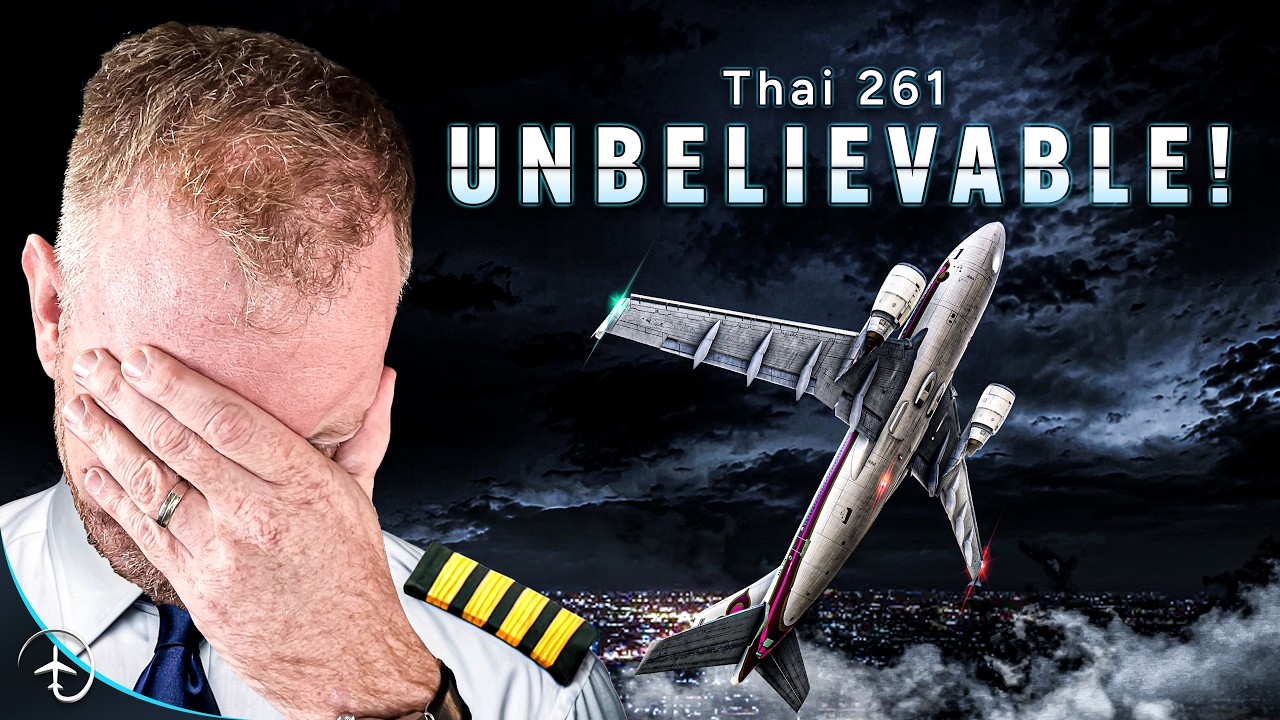
What makes this particularly significant is that the captain of Thai Airways Flight 261 understood the physics of the pitch-up moment perfectly — he had disconnected the autopilot himself seconds earlier. What he had failed to account for was how differently the aircraft would behave with the auto-throttle still active, driving engines to 102% N1 in eight seconds with no automated pitch compensation. Distracted by three failed approaches, he applied only a gentle push against a nose rising through 18 degrees, then 25, then 30, then past 40 — while the cockpit voice recorder captured him still processing the reasons for the previous failures. The investigation would later draw a direct parallel to the February 1998 China Airlines A300 accident near Taipei, in which a captain similarly failed to intervene during a runaway pitch-up because his mental model told him the autopilot was managing the aircraft when it was not. Both accidents share the same latent mechanism: not a knowledge gap, but an inaccurate expectation built from prior experience that no longer matched the actual system state.
"Oh, we can't make it, we cannot land!"
Auto-Throttle Left Engaged on Third Go-Around Set Fatal Pitch-Up in Motion
The pivotal technical failure aboard Thai Airways Flight 261 came down to a single omission: the captain disconnected the autopilot for the third go-around but left the auto-throttle engaged. On the previous attempt, the autopilot had absorbed the resulting pitch surge automatically; on the attempt before that, the captain had advanced thrust so slowly — over 23 seconds — that the pitch remained manageable. Those two experiences had silently shaped his expectations for what the aircraft would do next. This time, the auto-throttle drove the engines to maximum thrust, 102% N1, in just eight seconds. On a lightly loaded A310 with a slightly aft centre of gravity, that demanded an immediate, aggressive nose-down input. The captain, his attention still partly consumed by the failures that had preceded this moment, never made it.
Stall Warning Triggered 19 Seconds Into Go-Around as Captain Pulled Back Instead of Pushing Forward
Nineteen seconds after the go-around switches were pressed, the stick shaker activated and a loud cricket alarm filled the cockpit of Flight 261 — the aircraft hanging nearly motionless, nose pointed sharply skyward. The correct response, drilled into pilots through repeated training, is an immediate forward push on the controls to reduce the angle of attack. Instead, the captain pulled back. Several hypotheses exist for why this happens: a primal grab reflex triggered by sudden surprise, acute stress overriding trained responses, or a somatogravic illusion — where the powerful rearward acceleration of maximum thrust causes the vestibular system to misread pitch attitude, convincing a pilot that the aircraft is level or even descending when it is in fact climbing steeply toward a stall. This was not a single failure — it was a chain of events in which each link made the next one more likely.
Pitch Reached Nearly 60 Degrees as Flight 261 Entered Unrecoverable Stall at 1,880 Feet
The captain's sustained pull on the control column in the seconds after the stall warning transformed a dangerous situation into an unrecoverable one. Pitch climbed rapidly toward 60 degrees as airspeed collapsed below 30 knots, placing the aircraft in a fully developed aerodynamic stall at just 1,880 feet above the ground — insufficient altitude to rebuild energy even if recovery inputs had been applied immediately. With airflow lost across the ailerons, roll control disintegrated entirely, and the aircraft swayed violently: 120 degrees right, 50 degrees left, 60 degrees right and back again. The Ground Proximity Warning System issued a final alert in the seconds before impact.
Two Conflicting Approach Charts for the Same Runway Compounded Risks at Surat Thani
Thailand's Department of Aviation and Thai Airways were operating from different approach charts for the same runway at Surat Thani, and the discrepancies between them were operationally significant. The government chart specified a 204-degree inbound course, which would bring an aircraft across the extended runway centreline at 1,800 metres from the threshold — a workable geometry. Thai Airways' own chart specified 215 degrees, a course that crossed the centreline 3,500 metres out, demanding a much longer visual segment to complete the turn to land. Despite this, the Thai Airways chart listed only 2,000 metres as the minimum visibility — a figure that analysis suggests was materially insufficient for the approach it described. The investigation would later reveal that the actual required visibility for the Thai Airways chart was higher, but that figure appeared on neither document.
Insufficient Pitch Input Left Aircraft Climbing Uncontrolled Toward Stall Angle
With the autopilot disconnected and maximum thrust building rapidly, the captain of Flight 261 applied less than the available control authority to arrest the rising nose. Pitch climbed through 25 degrees, then 30, then 40. A brief forward input brought it back to approximately 30 degrees momentarily, but the correction was neither sustained nor aggressive enough, and the nose rotated upward again toward nearly 50 degrees — approaching the angle of attack at which the wings would stop generating lift. The investigation would later note this as evidence of a pilot insufficiently practiced in manual handling on an aircraft type that, precisely because of its automatic go-around capability, rarely demanded it.
Official Accident Report Criticised as Incomplete and Erroneous by Airbus Representative
The official investigation report into the crash of Thai Airways Flight 261 was described as among the weakest produced for an accident of its severity — shallow in analysis, missing critical data, and containing factual errors that were publicly challenged by a representative who participated in the investigation on behalf of Airbus. Reconstructing the sequence of events required working directly from raw flight data and applying human factors analysis to explain decisions the report had not adequately examined. Two systemic lessons emerge: the crew never developed the manual go-around proficiency that the aircraft and conditions demanded, and they pressed forward with multiple approaches under conditions they had every reason to know would prevent a safe landing — precisely the situation that published weather minima are designed to prevent.
Surat Thani Airport Had Lost ILS, Approach Lights, and PAPI Before Flight 261 Departed
By the time Thai Airways Flight 261 lifted off for Surat Thani in December 1998, the destination airport had shed so much of its navigational and lighting infrastructure that it no longer met ICAO minimum equipment standards for night or low-visibility operations. The instrument landing system had been out of service for an extended period. Approach lights had been removed in September. PAPI lights on the primary side were offline. The non-directional beacon was being relocated. And a failed electrical circuit had reduced runway edge lighting to every other lamp, doubling the spacing to six metres — above the 60-metre maximum ICAO permits for non-precision runways, and well beyond what allows a pilot to reliably identify the runway geometry in poor conditions. Each of these deficiencies had been individually notified to crews through official notices to airmen, but their cumulative effect — an airport functionally incapable of supporting a night approach in marginal weather — was not stated explicitly anywhere.
Pitch-Up Moment During First Go-Around Revealed Crew's Uncertain Grasp of Manual Handling
During the first go-around, the captain increased thrust slowly enough to keep the pitch broadly manageable, but the nose still climbed to 24 degrees before settling at 18 — a sign of imprecise manual control rather than confident intervention. The underlying aerodynamics are straightforward: on an aircraft with engines mounted below the centre of mass, increasing thrust acts as a rotational force, pushing the tail back and the nose upward. With the autopilot engaged, this tendency is counteracted automatically through nose-down elevator inputs. With it off, the pilot must supply that correction manually and promptly. What made this first go-around a warning sign, rather than a crisis, was only the slow rate of thrust increase. The third approach would not afford the same margin.
101 Killed in Thai Airways Flight 261 Crash, With Fire Accounting for Half the Deaths
Flight 261 struck a flooded plantation at 19:08:25 local time at a near-neutral pitch attitude but a high rate of descent. The swampy terrain and the aircraft's very low forward speed at the moment of impact — a consequence of the deep aerodynamic stall — limited the immediate death toll to 51 of the 146 people aboard. A fire that ignited in the left wing, however, then spread through the fuselage, trapping passengers who might otherwise have escaped. Medical examinations confirmed that 50 people died primarily from the fire, bringing the total to 101 dead, including both pilots. Only 45 survived.
Crew Pressed On With Approach as Visibility Fell 25% Below Their Own Chart Minimum
When the crew of Flight 261 contacted Surat Thani tower on approach, they were told that current visibility stood at 1,500 metres in light rain — 25% below the 2,000-metre minimum printed on the Thai Airways chart they were using. That minimum was already arguably insufficient for the geometry of the 215-degree offset approach; the actual visibility, compounded by the array of inoperative lights at the airport, made a successful visual alignment with the runway deeply improbable. The crew acknowledged the weather report and continued inbound.
Crew Descended to Minimum Altitude Despite Visibility Below Approach Limits
Passing the final approach fix six nautical miles from the VOR — the last legally permissible point to continue when visibility is below the chart minimum — the crew of Flight 261 descended toward the Minimum Descent Altitude of 430 feet as though the weather restriction did not apply. The official accident report neither flagged this as a serious violation nor attempted to explain it. Possible explanations include confusion arising from the two conflicting charts, one of which carried no visibility minimum at all, or a normalisation of deviation that had become embedded in Thai Airways operating culture. The investigation did not resolve which factor dominated.
Captain Ordered Third Approach After Two Failures Without Assessing Whether Conditions Had Improved
After two failed approaches to a runway he had not once been able to see clearly, the captain of Flight 261 directed the first officer to request a third attempt without pausing to discuss whether conditions had changed, whether a hold made sense, or whether Bangkok was the better destination. Industry practice, as applied at comparable carriers, prohibited re-attempts unless visibility had at minimum doubled from the previous try and was above the published minima. Neither condition was met. The first officer raised no objection. The captain, almost certainly under internal pressure to deliver his passengers, had narrowed his focus entirely onto the destination.
Weather Forecast Warned of Visibility Drops to 1,500 Metres Before Flight 261 Departed
The departure weather package for Surat Thani described generally acceptable conditions — seven kilometres of visibility, scattered cloud — but included an explicit caveat: intermittent convective cells could reduce visibility to 1,500 metres in rain, with variable winds gusting to 25 knots. That forecast figure precisely matched the threshold at which, given the airport's degraded lighting and absence of an instrument landing system, a safe approach would become extremely difficult. The pilots loaded 15.7 tonnes of fuel, enough to hold and return to Bangkok if needed, suggesting they anticipated the possibility of a delay — though not, it appears, the possibility of abandoning the destination entirely.
Tower Cleared Flight 261 to Land Without Visual Contact as First Go-Around Became Inevitable
Surat Thani tower cleared Thai Airways Flight 261 to land on a runway the controller could not see, issuing the clearance alongside a wind report but no visual confirmation of the aircraft's position. When the first officer briefly spotted lights through the mist, the captain disconnected the autopilot and autothrottle and began a manual approach — only for the first officer to immediately call a go-around on realising they were not aligned with the runway. Given a 215-degree offset approach in 1,500-metre visibility with a significant proportion of the runway lights inoperative, the misalignment was less a surprise than a predictable consequence of the conditions the crew had chosen to accept.
First Officer Could Not Distinguish Runway From Fishing Boat as Second Approach Failed
On the second approach, the captain was already audibly frustrated with the offset course before the runway came into view. When intermittent red lights did appear through the murk, the first officer could not determine whether they marked the runway threshold or a fishing boat — a confusion made entirely plausible by the number of runway edge lights that were inoperative. The aircraft drifted too far left of the centreline, and the captain initiated a second go-around. Crucially, the automatics had remained engaged throughout this approach, meaning the auto-throttle and autopilot handled the pitch surge smoothly in about eight seconds — an outcome that, as the investigation would later establish, built a false template in the captain's mind for what the third go-around would feel like.
Light Fuel Load Left A310 Unusually Susceptible to Pitch-Up Forces During Go-Around
Before departure, the crew loaded 15.7 tonnes of fuel — sufficient to reach Surat Thani, hold, fly multiple approaches, and return to Bangkok — producing a takeoff weight of approximately 108 tonnes on an aircraft with a maximum of around 150 tonnes. The aircraft was therefore significantly lighter than its design centre. What appeared to be prudent contingency planning carried a less visible consequence: on a light A310 with a slightly aft centre of gravity, the pitch-up moment generated by a rapid increase in engine thrust would be considerably more pronounced than on a heavier aircraft, demanding faster and more forceful corrective inputs from the pilot flying manually. The crew did not discuss this implication.
Summarised from Mentour Pilot · 44:27. All credit belongs to the original creators. Streamed.News summarises publicly available video content.