Original source: Mentour Pilot
This video from Mentour Pilot covered a lot of ground. 10 segments stood out as worth your time. Everything below links directly to the timestamp in the original video.
The image that convinced hundreds of eyewitnesses they had seen a missile attack was actually the burning, noseless fuselage of the aircraft itself, climbing on its own momentum. Understanding the physics resolves one of aviation's most persistent conspiracy theories.
Burning Tailless Fuselage, Not a Missile, Fooled Hundreds of TWA 800 Witnesses
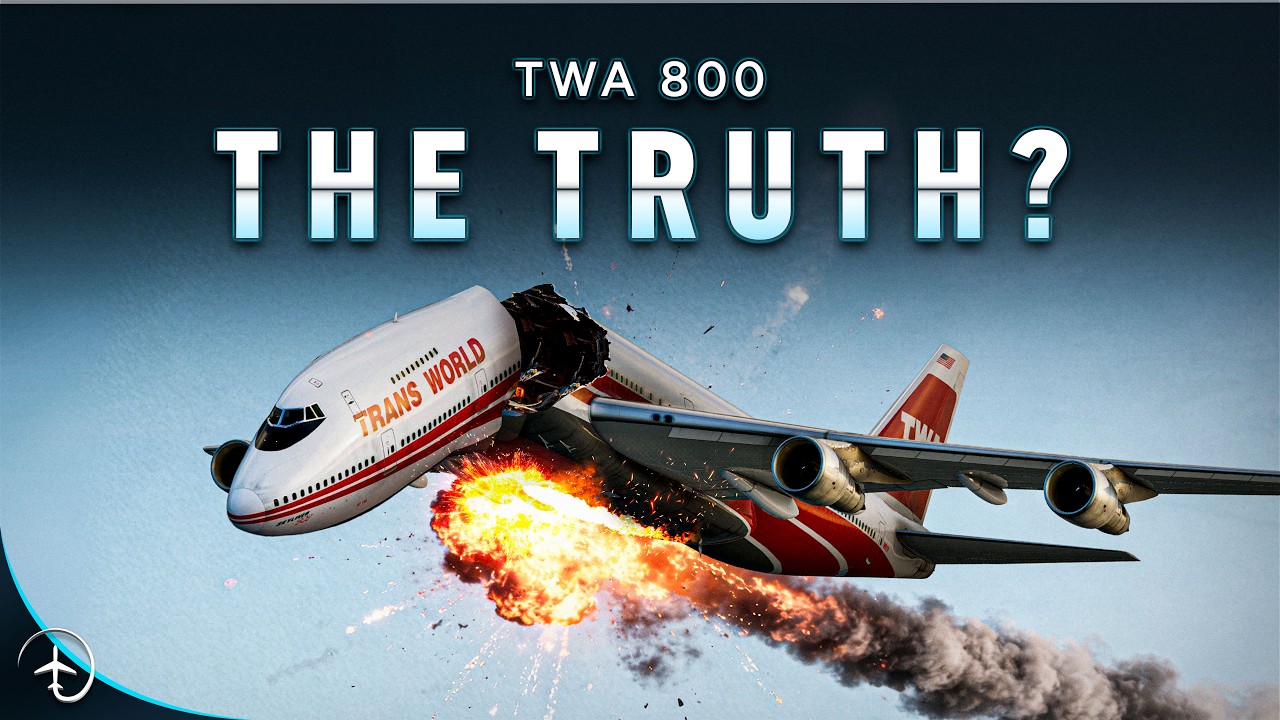
When the nose section of TWA Flight 800 separated, the loss of pitch balance caused the remaining fuselage to rear upward violently, climbing a further 2,000 to 3,000 feet on residual momentum and engine thrust before stalling at nearly 16,000 feet, rolling right, and plunging vertically into the Atlantic. The burning aft section, trailing fire through the darkening sky, produced exactly the kind of rising streak that hundreds of witnesses interpreted as a missile — a misreading reinforced by decades of Hollywood imagery rather than the actual behaviour of surface-to-air weapons, which burn their motors briefly near the ground and coast the rest of the way in near-darkness.
The forensic record is unambiguous: aircraft struck by missiles, such as Malaysia Airlines MH17 and Azerbaijan Airlines flight 8243, show characteristic widespread shrapnel peppering across the fuselage — a signature entirely absent from Flight 800's reconstructed wreckage. The aerodynamic explanation for the witness accounts, grounded in radar tracking and reverse ballistic analysis, closes the evidentiary gap that conspiracy theories have exploited for nearly three decades.
"Real missiles shoot off burning their motors hard for a few seconds and then coast for most of their flight."
TWA Flight 800 Broke Apart in Three to Five Seconds After Fuel Tank Ignition
At 20:31:12 on the evening of 17 July 1996, a single electrical arc ignited the fuel-air mixture inside the centre wing tank of TWA Flight 800, triggering a deflagration — a rapidly propagating flame front rather than an instantaneous detonation — that nevertheless generated overpressure sufficient to destroy the tank's structural integrity in seconds. The cascading failure was brutally sequential: a spanwise beam separated and struck the front spar, the spar collapsed onto the frames beneath it, the unsupported fuselage skin tore open, and finally the keel beam — the longitudinal spine of the aircraft — fractured, splitting the 747 into two pieces. The entire sequence, from initial spark to the nose section falling free, consumed just three to five seconds.
What makes this sequence analytically significant is how it demonstrates that the centre wing tank is not an isolated void but a load-bearing structural element woven into the wing box itself. Its destruction did not merely release energy — it removed the very members that held the airframe together.
"The time that it took from that initial spark in the tank to the entire nose section falling away was just three to five seconds."
Forensic Reconstruction of TWA 800 Wreckage Ruled Out Missile or Bomb with Physical Certainty
When investigators reassembled the recovered wreckage of TWA Flight 800, the physical evidence told a consistent and one-directional story. Metal skin had peeled outward from the centre wing tank, structural members bore witness marks from internal collision forces, and soot deposits on interior surfaces followed patterns characteristic of combustion originating inside the tank. None of these signatures matched what an external explosive device produces — inward-driven deformation, chemical residues of high explosives, and widespread shrapnel perforations.
Despite detailed chemical and forensic analysis of every recovered component, investigators found no explosive residue, no detonation signatures, and no fragments consistent with a warhead or bomb casing. The small traces of energetic material detected on a handful of isolated pieces were ultimately attributed to contamination from military recovery vessels, given their absence of any consistent spatial pattern. The conclusion was reached through evidence, not assumption.
Silver Sulfide Deposits on Ageing Wiring Identified as the Likely Ignition Trigger in TWA 800 Disaster
Investigators identified the probable final link in the causal chain as silver sulfide contamination on the Fuel Quantity Indicating System (FQIS) wiring inside the centre wing tank. When the silver-plated copper conductors used throughout the aircraft's electrical systems were exposed to sulphur compounds naturally present in jet fuel, they produced silver sulfide — a compound with markedly lower electrical resistance than clean metallic silver, increasing the likelihood of arcing between exposed conductors. Because the centre wing tank was filled less frequently than the wing tanks, any contamination that accumulated there was not periodically washed away, allowing deposits to build undisturbed.
Boeing had been aware of silver sulfide formation across its fleet but classified it as a nuisance rather than a safety-critical condition. That misclassification meant a known chemical degradation mechanism was left unaddressed in fuel tank wiring, across an entire generation of airliners, until a catastrophic failure forced a reckoning.
"Silver sulfide was likely the last piece of the puzzle — the means by which a short circuit released enough energy to ignite the flammable fuel-air mixture inside the tank, like a spark plug."
Air Conditioning Packs Heated TWA 800's Centre Tank to the Flammable Range Before Takeoff
The two air conditioning packs aboard TWA Flight 800, running continuously on the ground at JFK to cool the cabin on a warm July evening, were positioned almost directly beneath the centre wing tank with minimal thermal insulation separating them from the tank's lower surface. The heat they shed into the aircraft structure gradually warmed the small quantity of residual fuel remaining in the tank, driving the fuel-air vapour concentration into what engineers call the flammable range — the narrow band within which ignition becomes possible.
Critically, this condition was not considered abnormal. Studies conducted after the accident revealed that fuel tank vapours fall within the flammable range for a significant proportion of flight time, rising to roughly 30 percent of the time in tanks located near air conditioning equipment. The industry's design philosophy treated flammable vapour as an unavoidable constant, placing all safety reliance on the exclusion of ignition sources — a single defensive layer that the TWA 800 accident would prove catastrophically insufficient.
Post-Accident Inspections Found Arcing Wires and Metal Shavings in Aircraft Across the Fleet
Following the TWA 800 investigation, inspectors examined airliners of various types and ages and found that serious wiring degradation was effectively universal. Metal shavings left during maintenance procedures had settled inside wiring conduits, insulation was commonly damaged, and on several aircraft there was physical evidence that wires had previously arced, melted together, and self-extinguished without detection. The implication was stark: the design assumption that ignition sources could be reliably excluded from fuel tanks was already false across the operating fleet, and had been for years. A 1990 Philippine Airlines Boeing 737 explosion on the ground in Manila — which killed eight passengers and injured 82 — had already demonstrated this vulnerability six years before TWA 800.
The 1990 Manila accident pointed directly to the same failure mode: a faulty float switch, energised by a short circuit, arced inside a centre tank containing flammable vapour. That precedent went unaddressed at the systemic level.
Investigators Concluded a FQIS Short Circuit Was the Near-Certain Ignition Source on TWA 800
Because much of the wiring in the most critical areas was either destroyed or heavily damaged, investigators could not identify a single definitive ignition point. What they found instead was a convergence of vulnerabilities: arcing signatures on high-power generator cables that had been routed in close proximity to FQIS wiring, additional arcing damage in an area that had undergone structural repairs and been exposed to water leaks, metal shavings located within inches of where a missing wire bundle connecting centre tank sensors would have run, and FQIS wiring bundled with high-energy lighting circuits and cockpit voice recorder wiring. Taken together, these conditions pointed with near-certainty to a short circuit that delivered a voltage surge far exceeding the FQIS system's low-energy design parameters directly into the tank probes.
The accident, investigators concluded, did not arise from a single dramatic failure but from the alignment of several individually unremarkable conditions — a textbook illustration of James Reason's Swiss cheese model of systemic risk.
TWA 800 Investigation Reshaped Fuel Tank Safety Rules and Made Inerting Systems Mandatory Fleet-Wide
The investigation that followed the destruction of TWA Flight 800 recovered and physically reconstructed 98 percent of the aircraft — one of the most complete wreckage reassemblies in NTSB history — enabling investigators to trace deformation patterns, burn signatures, and structural separations with a precision sufficient to explain, and prove, exactly how an airliner had come apart. The inquiry took nearly four years and stood as one of the most extensive aviation investigations ever conducted. Its conclusions fundamentally reordered the industry's approach to fuel tank safety, establishing that flammable vapour suppression, not merely ignition-source exclusion, was the required standard. By approximately 2018, virtually all commercial airliners had been fitted with nitrogen-based fuel tank inerting systems designed to displace flammable oxygen from tank headspace.
Equally consequential were the changes to wiring philosophy: the investigation demonstrated that electrical insulation, unlike metal structures, degrades invisibly over decades and can accumulate latent failure potential without triggering any standard inspection flag. Wiring condition, contamination environments, and connector integrity subsequently became central to long-term airworthiness assessments across the industry.
Lack of FAA Wiring Separation Rules Left FQIS Cables Bundled with High-Voltage Lines on Boeing 747s
The Fuel Quantity Indicating System on the Boeing 747 used low-voltage capacitance probes whose inherent safety depended entirely on two conditions: complete electrical isolation from higher-energy circuits, and insulation that remained intact throughout the aircraft's service life. Neither condition was reliably guaranteed. Because no FAA regulation required FQIS wiring to be physically separated from high-voltage cables on Boeing models — a requirement that manufacturers such as McDonnell Douglas applied voluntarily, mandating at least three inches of separation — FQIS cables on many 747s were routed in the same densely packed bundles as cabin lighting supply lines and generator feeds carrying vastly greater energy levels.
As insulation aged, cracked, or was disturbed during maintenance, the barrier between low-energy sensor wiring and high-voltage supply lines became increasingly notional. The investigation into TWA 800 revealed that this regulatory gap had left an entire generation of airliners with a structural vulnerability in their electrical architecture that visual inspections, focused on obvious damage, were poorly equipped to detect.
Twenty-Six Fuel Tank Explosions Before 1996 Had Already Exposed the Limits of Ignition-Source Exclusion
By the time TWA Flight 800 departed JFK on 17 July 1996, the aviation industry had recorded 26 separate fuel tank explosions in transport-category aircraft since 1959, triggered by causes ranging from lightning strikes and short circuits to equipment malfunctions. A Boeing 707 had crashed in Maryland after lightning ignited a vapour-filled tank; a Royal Iranian Air Force Boeing 747 had gone down near Madrid in 1976 after lightning entered a partially empty wing tank. The accumulated record was a direct challenge to the prevailing safety philosophy, which placed all reliance on keeping ignition sources out of tanks that were routinely allowed to contain flammable vapour.
The fundamental flaw in that logic — that a single defensive layer, if breached, left no secondary protection — had been demonstrated repeatedly before TWA 800. The accident was not the first warning; it was the one that finally forced a systemic response.
Summarised from Mentour Pilot · 48:08. All credit belongs to the original creators. Streamed.News summarises publicly available video content.