Original source: Mentour Pilot
This video from Mentour Pilot covered a lot of ground. 8 segments stood out as worth your time. Everything below links directly to the timestamp in the original video.
The crash of Flight 293 was not caused by one mistake. It was the product of a day in which almost everything that could go wrong did — and no one stopped the clock.
Miami Air Flight 293's Fatal Chain of Errors Began Before Takeoff
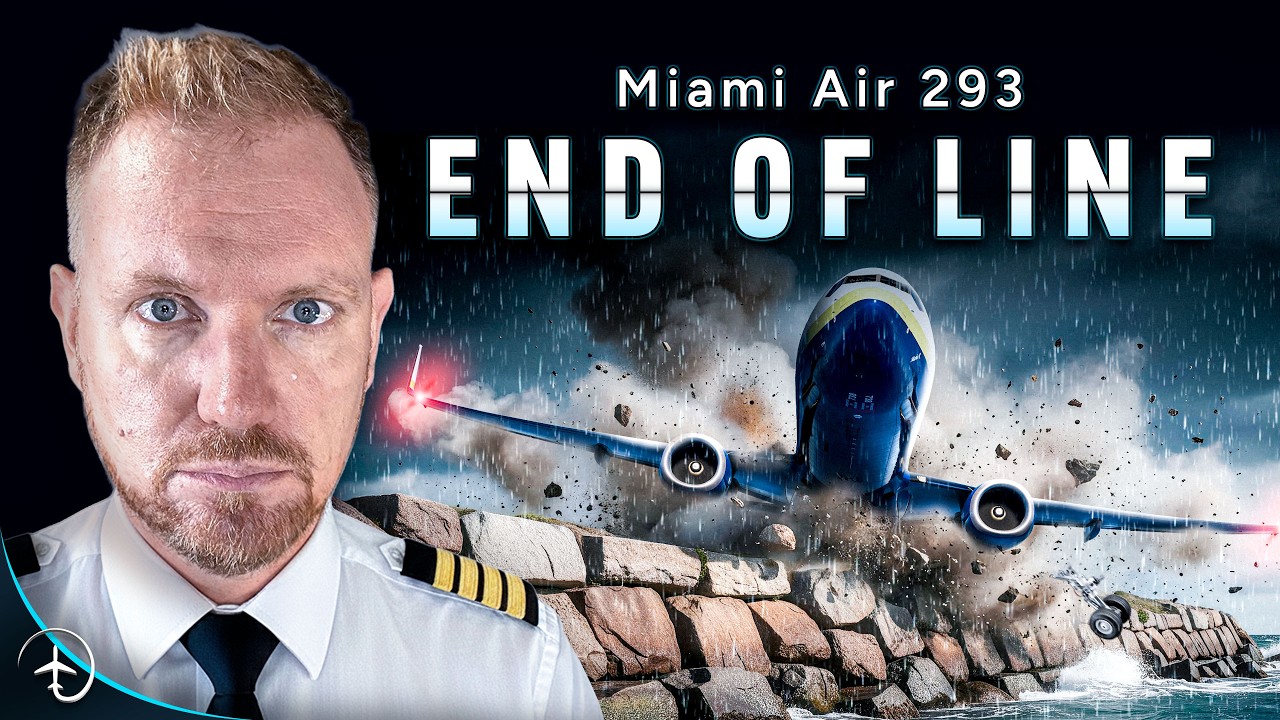
On May 3rd, 2019, Miami Air International Flight 293 — a Boeing 737 chartered by the U.S. military to service Naval Station Guantanamo Bay — began accumulating problems from the earliest stages of its journey. The airline operated regular rotations between the continental United States and the isolated Cuban base, carrying military personnel, their families, and civilian contractors.
What makes this case significant is not any single dramatic failure but the gradual compounding of small decisions and overlooked warnings that together produced a catastrophic outcome — a pattern that investigators would later find deeply embedded in the airline's operational culture.
Flawed Braking Assumptions Left Flight 293 Cleared to Land on a Runway It Could Not Stop On
Before Flight 293 ever reached Jacksonville, its dispatchers had calculated landing performance using a braking action value of five — the equivalent of 'good' — to account for a potentially wet runway at Naval Air Station Jacksonville, an 8,000-foot strip they deemed sufficient even with one thrust reverser inoperative. What that calculation concealed was how little margin actually existed once real-world conditions diverged from the assumed ones.
The procedure embedded a dangerous optimism: so long as several nominal conditions held, no in-flight recalculation was required. That assumption would prove critical once the weather deteriorated sharply on approach.
Crew Pressed Ahead Through Thunderstorm Over Jacksonville Despite FAA Guidance Against It
Weather radar at the time of Flight 293's approach showed a large storm cell parked directly over Jacksonville — conditions that FAA guidance explicitly identifies as requiring a hold or a divert. Wind shear, turbulence, hail, and intense rain are among the hazards that make approaches into active thunderstorms dangerous by definition. The crew continued regardless, most likely influenced by duty time constraints and the accumulated fatigue of a difficult day — a pressure pattern known in aviation safety circles as 'get-there-itis.'
This psychological trap, in which the desire to land overrides sound aeronautical judgment, is a well-documented contributor to accidents and represents one of the earliest points at which Flight 293's outcome could have been redirected.
FAA Warned Airlines About Ungrooved Runway Hazards in 2015. Miami Air Never Updated Its Procedures.
As Flight 293 descended toward Naval Air Station Jacksonville, rainfall was exceeding six centimetres per hour over Runway 10/28 — a surface without grooves, meaning water pooled evenly rather than draining toward the edges. The FAA had issued a safety alert as far back as 2015 warning that ungrooved wet runways could degrade braking action by 30 to 40 percent below theoretical predictions, and urging airlines to assume no better than medium braking in such conditions. Miami Air had never incorporated that guidance into its training or standard operating procedures.
The consequence was that by 2019, the airline's crews were still being told to assume good braking on a wet runway — a standard that the FAA's own findings had effectively invalidated four years earlier.
Viscous Hydroplaning on a Thin Film of Water Made Braking on Flight 293's Runway Nearly Impossible
The FAA's own definition of a 'wet' runway spans an enormous range — from 25 percent surface coverage with minimal moisture all the way to 100 percent coverage with up to three millimetres of standing water — a spread so wide that it obscures meaningful differences in braking performance. More critically, even water depths below that three-millimetre threshold are sufficient to trigger viscous hydroplaning, a condition in which a thin lubricating film prevents tyres from gripping the surface. Post-accident calculations indicated that approximately three millimetres of water had accumulated on the ungrooved runway during Flight 293's approach. Despite a tailwind that had exceeded the five-knot threshold requiring a landing performance recalculation under Miami Air's own procedures, the crew ran no new numbers. Even if they had, the airline's inflated braking assumptions would still have told them it was safe to land.
The regulatory ambiguity around wet runway classification created a gap wide enough for a catastrophic accident to pass through undetected.
Missed Checklist Step and Failure to Call Go-Around Compounded an Already Unstable Approach
Transferred to the radar final controller for the last phase of the approach, Flight 293 was already above the normal glide path — a consequence of the late extension of high-drag devices and the tailwind pushing the aircraft forward faster than anticipated. The captain disconnected the autopilot and increased the descent rate sharply in an attempt to recover the profile, while the first officer worked through the landing checklist under pressure. He called out 'speed brakes armed' without verifying that the lever was actually in the armed position — a phenomenon investigators recognise as checklist callout without physical verification, common under high workload. The speed brakes were therefore not armed. By the stabilisation gate of 1,000 feet, the approach met none of the criteria that required it to continue. Neither pilot called it out. Neither executed a go-around.
Flight 293 Crossed Into the St. John's River at 80 Knots After Hydroplaning Through All Braking
Crossing the runway threshold at 120 feet altitude, 17 knots fast, and with a 10-knot tailwind, Flight 293 touched down 1,580 feet beyond the designated touchdown zone. The single functioning thrust reverser engaged and pulled the aircraft to the right; the auto brakes activated, but the unarmed spoilers failed to deploy immediately, costing critical braking force in the first seconds of the ground roll. When the spoilers finally extended automatically — triggered by a safety system detecting the discrepancy — the aircraft was already travelling at 180 knots ground speed. Viscous hydroplaning had reduced tyre contact with the runway to near zero, rendering the anti-skid system counterproductive: it kept reducing brake pressure to prevent wheel lock, even as the crew applied maximum manual braking. The Boeing 737 departed the runway end at approximately 80 knots, crossed 350 metres of grass, struck a sea wall, and plunged into the St. John's River. All 143 occupants escaped with minor injuries. Several animals carried in the cargo hold drowned.
"I got it! I got it!"
NTSB Finds Viscous Hydroplaning Caused Flight 293 Overrun; FAA Tightens Wet-Runway Standards
The National Transportation Safety Board attributed the accident to extreme loss of braking friction caused by viscous hydroplaning on an ungrooved, water-saturated runway. The board stopped short of finding the crew's actions causal, but concluded the accident was entirely avoidable had the pilots discontinued the unstabilised approach. The failure to arm spoilers and the long touchdown point were identified as factors that increased the aircraft's speed at runway departure and thereby worsened the outcome. The FAA responded by issuing a new Safety Alert for Operators superseding the 2015 guidance, directing airlines to treat runways as contaminated — not merely wet — during heavy rain on ungrooved surfaces. Miami Air implemented a series of operational and training reforms before the COVID-19 pandemic drove it out of business.
Runway overruns are one of the few accident categories that is increasing in frequency, making the ambiguities exposed by Flight 293 — in braking action standards, unstabilised approach culture, and regulatory enforcement — an active and unresolved safety concern across the industry.
Summarised from Mentour Pilot · 40:45. All credit belongs to the original creators. Streamed.News summarises publicly available video content.