Original source: Mentour Pilot
This video from Mentour Pilot covered a lot of ground. 17 segments stood out as worth your time. Everything below links directly to the timestamp in the original video.
Understanding why experienced pilots made a catastrophic navigational error starts with the airport's layout — and how well the crew thought they knew it.
Two Runways, One Fatal Confusion: How Blue Grass Airport's Layout Set the Stage for Disaster
At Blue Grass Airport in 2006, Runway 22 served nearly all commercial traffic — a fully lit, 7,000-foot strip built for airline operations. Running across it sat Runway 26, a 3,500-foot general aviation strip with sparse lighting, half the usable width, and a share of total traffic barely reaching 2%. The physical proximity of these two very different runways, at an airport the crew knew well, created the geographic precondition for the accident.
Familiarity, the investigation would show, is its own hazard. A crew that has flown a routing dozens of times stops actively reading the environment and begins moving on autopilot — and at an airport where the wrong runway was close, short, and dark, that habit proved fatal.
Skipped Taxi Briefing and Implicit ATC Clearances Eroded the First Line of Defence
Despite Comair's own procedures requiring a full taxi briefing before the first departure of the day, the captain dismissed the requirement with a brief 'standard taxi' — a judgment call that stripped away an early opportunity to anchor the crew's situational awareness. Compounding this, the prevailing air traffic control system automatically authorised aircraft to cross Runway 26 en route to Runway 22 without any specific crossing clearance, meaning crews were never procedurally required to pause, identify, or call out their position at that intersection.
What makes this particularly significant is that two independent safeguards — the briefing and the crossing callout — both dissolved before the aircraft had even left the ramp, leaving no procedural tripwire in place for the errors that followed.
A Safety Notice About Missing Lights Primed the Crew to Ignore a Critical Warning Sign
A notice to airmen, or NOTAM, issued during construction at Blue Grass Airport warned that the runway-end identifier lights on Runway 22 were out of service. The first officer had personally observed comparable lighting deficiencies on an earlier flight. This procedural transparency — designed to inform crews of hazards — had an unintended consequence: it conditioned both pilots to expect a darker, less illuminated runway environment than usual. The departure was scheduled around thirty minutes before sunrise on a cloudy night, with no city lights beyond the airport boundary to provide contrast.
The investigation would later reveal that this priming effect transformed a critical warning sign — the near-total darkness of Runway 26, which had no edge lighting at all — into something that felt entirely consistent with what the crew had been told to expect.
Cockpit Voice Recorder Reveals Sterile Cockpit Rules Were Broken During Critical Taxi Phase
As the aircraft taxied through the pre-dawn quiet of Blue Grass Airport, the cockpit voice recorder captured the two pilots engaged in relaxed conversation about pay rates, working conditions, and competitor airlines — topics with no bearing on the departure ahead. Sterile cockpit rules, mandated by regulation and reinforced by airline policy, explicitly prohibit this kind of non-essential talk during taxi, takeoff, climb, and approach, because those are the phases when situational awareness is most vulnerable to distraction.
The recording makes clear that the attention of both pilots had drifted away from monitoring their taxi routing at precisely the moment when active observation could have prevented the sequence of errors that followed.
An Audible Yawn on the CVR Marked the Moment the Aircraft Stopped at the Wrong Runway
As the first officer worked through the taxi checklist, his voice carried what investigators interpreted as a yawn — noted not as evidence of clinical fatigue, but as a concrete reminder that the crew was operating during a circadian low period, the early morning window when alertness characteristically dips even in rested individuals. Shortly afterward, the aircraft came to a stop just short of Runway 26, a holding point the crew had no clearance or reason to occupy.
This stop was the first physical link in the accident chain — and it went entirely unremarked inside the cockpit, folding seamlessly into the crew's shared mental model of a routine departure.
Crew's Mental Model Jumped Ahead of Reality — and Neither Pilot Noticed
The taxi clearance authorised the crew to cross Runway 26 and proceed to the holding point for Runway 22. Instead, the aircraft stopped at Runway 26 itself — a deviation that went unacknowledged. There was no verbal callout identifying the runway, no pause, and no question. The cockpit voice recorder captured the stop registering as nothing more than routine progress, the crew's shared mental model having silently reclassified their position from a runway crossing to an arrival at their departure runway.
This was not a single failure — it was the moment when perception and reality parted company, and no procedure or habit was present to force a reconciliation.
Airport Construction Reshaped Taxiway Alpha, Making the Wrong Turn Feel Identical to the Right One
Under pre-construction conditions, Taxiway Alpha extended beyond the Runway 26 intersection, requiring the captain to make two sequential left turns before aligning with Runway 22 — a sequence that experienced crews had absorbed as muscle memory. When construction truncated that extension and relabelled what had been Taxiway A5 as the continuation of Taxiway Alpha, the routing changed in a way that was subtle but consequential: the steering input now required to enter Runway 26 was nearly identical to what the captain's hands had always done when lining up for Runway 22.
The investigation would later reveal that infrastructure changes, even modest ones, can inadvertently manufacture conditions where the wrong action feels procedurally correct — a trap that no amount of pilot experience reliably guards against.
Single Controller, Multiple Duties, and an Assumption That No Commercial Crew Would Use Runway 26
The air traffic controller on duty that morning was working alone, despite FAA guidance recommending two controllers when tower and radar functions were combined — a standard that was so poorly defined that single-controller overnight operations had become routine at Blue Grass Airport. His responsibilities that night spanned ground movement authorisation, takeoff clearances, radar coordination, and administrative tasks simultaneously. Crucially, in more than a decade of experience at the airport, he had never once observed a commercial aircraft depart from Runway 26, and had no reason to expect otherwise.
The systemic consequence was that the one external check capable of catching the crew's error — an alert controller tracking an aircraft's ground position — was operating under conditions that made such vigilance structurally difficult.
Wrong Call Sign, No Runway Number: Two More Missed Chances Before the Takeoff Roll Began
When the first officer contacted the tower to request departure clearance, he transmitted under the wrong call sign — a small error that went unchallenged by the controller. The clearance that came back contained no runway number, only a heading instruction. Neither the misidentification nor the omission triggered any pause in the cockpit. The captain released the brakes and turned onto what both pilots were fully convinced was Runway 22, the first officer completing his line-up checks without a single indication that anything felt wrong.
Two small procedural gaps — an uncorrected call sign and a clearance stripped of its most critical identifier — had aligned to remove the last external checkpoint before the aircraft committed to its takeoff roll.
"Line-up checks complete."
Large '26' Markings, Lit Signs, and a 40-Degree Compass Error — All Ignored
The clues available to the crew were neither subtle nor ambiguous. The numeral '26' was painted in large characters on the runway surface directly ahead. Illuminated taxiway signs on the sides of the pavement clearly identified the runway. The aircraft's own magnetic compass read approximately 40 degrees away from the heading associated with Runway 22, and the heading bugs both pilots had manually set to their planned departure heading showed the same significant discrepancy. Any one of these cues, actively observed, would have been sufficient to avert the accident.
None of them registered — not because they were invisible, but because neither pilot was looking. Expectation bias had already decided where they were, and the cockpit had drifted into a state where observation was passive rather than deliberate.
Comair Had No Mandatory Heading Cross-Check, and the NOTAM Made the Darkness Feel Normal
Comair's procedures required crews to set their heading bugs to the departure runway — but stopped short of mandating an explicit cross-check that compared the bug setting against the compass before takeoff, a verification step the FAA had already recommended operators adopt. That single missing requirement meant the heading discrepancy sat directly in front of both pilots without ever prompting a formal challenge. Meanwhile, outside the windows, Runway 26's complete absence of edge lighting produced a darkness that would ordinarily have felt alarming — but the NOTAM about Runway 22's missing identifier lights had already primed the crew to expect exactly that.
The irony is stark: a legitimate safety advisory conditioned the pilots to rationalise away the most visually obvious sign that something was wrong.
Expectation Bias Filtered Every Anomaly Through a Flawed Assumption — Until It Was Too Late
By the time the crew completed their final pre-takeoff steps, expectation bias had become self-reinforcing. Every cue that did not conform to the mental model of Runway 22 was silently absorbed and rationalised — the missing lights explained by the NOTAM, the narrower pavement unregistered, the compass discrepancy unexamined. Without a mandatory cross-check to force a moment of deliberate verification, the crew's subconscious simply found a reason for each anomaly and moved on. The thrust levers advanced, and the aircraft began accelerating into the darkness of a runway less than half the length it needed.
This was not negligence — it was the predictable outcome of a cognitive trap operating in an environment that had removed every procedural mechanism capable of breaking it.
'That's Weird With No Lights' — The Warning That Came Ten Seconds Too Late
Ten seconds into the takeoff roll, the first officer voiced a quiet unease: 'That's weird with no lights.' The comment was real — a fragment of situational awareness surfacing from beneath the expectation bias — but it arrived into a cockpit already primed to dismiss it. The NOTAM about missing runway lights provided an instant rationalisation, and the captain's response was a soft 'yeah' that closed the question before it could open. What neither pilot recognised was that by the time those words were spoken, the aircraft had already accelerated past the speed at which a safe rejected takeoff on Runway 26 was possible. The decision window had closed invisibly, before anyone realised it existed.
Investigators later concluded that the crew's mental model had jumped from 'approaching Runway 26' to 'holding on Runway 22' at some point during their distracted taxi — a silent cognitive leap that no instrument, no sign, and no callout had been in place to interrupt.
"That's weird with no lights."
Premature Rotation Call at 131 Knots Marked the Captain's Final, Desperate Attempt to Survive
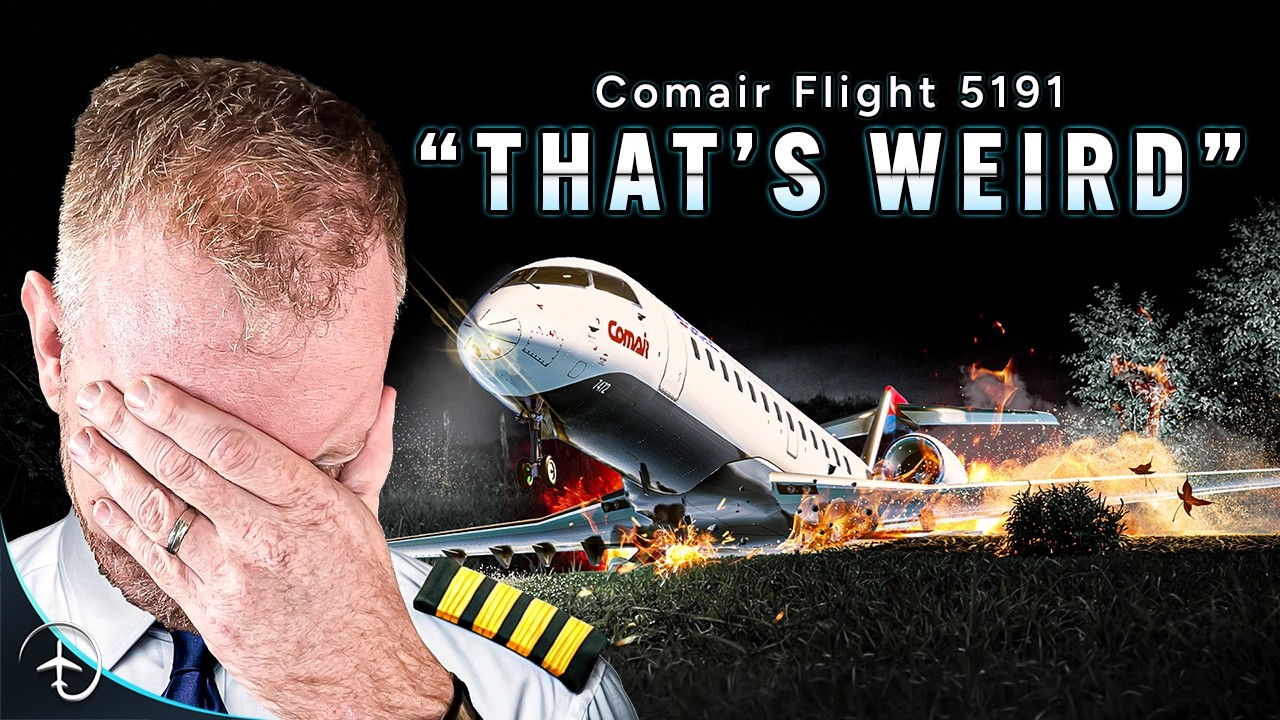
As the runway end rushed toward them, the captain called 'V1, rotate' — but the aircraft had reached only 131 knots, well below the calculated rotation speed of 142 knots. It was not a procedural call; it was a last-second attempt to force the aircraft into the air before the pavement ended. The nose began to rise, but the main landing gear was still rolling when it ran out of runway and struck a structure beyond the threshold, tearing the gear away. The aircraft became briefly airborne in a damaged state, struck trees, and then slammed into the terrain, breaking apart and igniting almost immediately.
The gap between 131 and 142 knots — eleven knots — was the measure of how little margin remained when a crew finally understood, with no time left, that they were on the wrong runway.
"Whoa!"
49 Dead, One Survivor With No Memory: The Cognitive Failure That Operated Below Conscious Awareness
The controller in the tower noticed the accident not as an event but as an absence — no aircraft climbing away on the expected corridor, no radio calls. In total, 49 of the 50 people aboard Comair Flight 5191 were killed. The sole survivor, the first officer, escaped with severe injuries including brain damage that left him with no memory of the flight and unable ever to fly again. Even had his recollection been intact, investigators concluded he would likely have been unable to identify the precise moment his mental model diverged from reality.
The investigation would later articulate why: these cognitive transactions occur below the threshold of conscious awareness. By the time a crew recognises that their mental model is wrong, the aircraft — and the situation — has already moved beyond the point of recovery.
NTSB Finds Sterile Cockpit Breach and Structural ATC Flaw at Root of Comair Disaster
The National Transportation Safety Board concluded that the crew of Comair Flight 5191 failed to use the cues and verification tools available to them, and failed to confirm their runway alignment before beginning the takeoff roll. Investigators identified two contributing factors of particular weight. The first was the violation of sterile cockpit rules: the cockpit voice recorder made clear that the crew's attention had been occupied with conversation unrelated to the departure during the most critical phase of the ground operation. The second was structural — the prevailing ATC procedure allowed a taxi clearance to implicitly authorise the crossing of intervening runways, removing the moment of forced awareness that an explicit crossing instruction would have required.
These were not isolated failures. They were a cockpit that had drifted from disciplined monitoring, operating within a wider system that had quietly removed several of the checkpoints that might have caught it.
Comair Crash Forced US Aviation to Replace Assumed Clearances With Explicit Runway Verification
In the aftermath of the accident, Comair revised its procedures to mandate explicit departure runway verification before takeoff — converting what had previously been an assumed step into a required, deliberate action that forced crews to look up, look out, and confirm their position. Across the broader US air traffic system, the principle of assumed runway crossing clearances was progressively retired, with controllers directed to issue specific instructions each time an aircraft needed to cross a runway. Takeoff clearances that omitted the runway number were formally discouraged, removing one more avenue for unchallenged assumption. These procedural changes were reinforced by expanded use of runway status lights, additional controller training on incursion prevention, and the gradual spread of ground surveillance technology beyond major airports.
Each reform addressed a distinct layer of the failure chain — a recognition that no single fix was sufficient, and that the lesson of Flight 5191 was systemic rather than individual.
Summarised from Mentour Pilot · 40:49. All credit belongs to the original creators. Streamed.News summarises publicly available video content.