Original source: Mentour Pilot
This video from Mentour Pilot covered a lot of ground. 11 segments stood out as worth your time. Everything below links directly to the timestamp in the original video.
A string of unresolved mechanical failures, accepted one by one as manageable, collectively put a supersonic military jet on an invisible collision course with a commercial airliner.
Cascading Equipment Failures Left F-4 Phantom Flying Blind Into Civilian Airspace
By the time Phantom 458 departed Fallon Naval Air Station on June 6, 1971, it was operating with a dead transponder, degraded nose radar, a failed radio that had only partially been restored, and an oxygen leak severe enough to cap the crew's operational altitude. Maintenance teams at multiple stops along the route lacked the parts or expertise to fix the core problems, and the decision was made to press on anyway. What makes this significant is not any single failure but their accumulation: each deficiency individually might have been manageable, but together they forced the crew into a flight profile — low-altitude, uncontrolled, transponderless — that placed them on a collision course with one of the busiest departure corridors in the United States.
Broken Transponder Forced Military Jet Into Uncontrolled Airspace Shared With Commercial Traffic
Because Phantom 458's transponder was inoperative, instrument flight rules — which require functioning identification equipment and continuous radar contact — were not an option. The crew's only legal recourse was to descend below the controlled airspace layers and fly under visual flight rules, effectively operating as an extraordinarily fast general-aviation aircraft with no obligation to contact air traffic control. Below the area of positive control, which began at 18,000 feet in 1971, responsibility for separation rested entirely with pilots scanning out their windows — a principle that mid-air collision records throughout the 1950s and 1960s had already demonstrated was dangerously inadequate in high-density corridors.
1971 Airspace Design Left Climbing Airliners Briefly Unprotected From Uncontrolled Traffic
In 1971, positive control — the regime in which controllers maintained continuous radar separation — did not extend down to the ground. Departing airliners climbed through an intermediate band of airspace where radar coverage was limited and separation guarantees evaporated, before eventually entering the protected upper layers. During that transitional climb, a jet following a published high-density departure route could legally share altitude with a VFR aircraft that had no transponder and no obligation to speak to anyone. That structural gap, not recklessness by any individual crew, created the conditions in which a military fighter and a commercial DC-9 could converge undetected.
Worsening Haze Forced Phantom to 15,500 Feet — Directly Into LAX Departure Corridor
Approaching the San Gabriel Mountains, the visibility that had permitted low-level flight deteriorated sharply, haze erasing the terrain contrast the pilot needed to maintain safe clearance. To stay visual with the ground and avoid the rising foothills, the crew climbed hard, pulling the aircraft up to 15,500 feet — below the 18,000-foot threshold of positive control, still legal under visual flight rules, but directly intersecting the eastbound jet departure routes out of Los Angeles International Airport. At that same altitude and moment, Hughes Airwest Flight 706 was climbing through the same airspace under instrument rules, in radio contact with Los Angeles Center, but with no knowledge of the military aircraft closing rapidly from the west.
Phantom's Broken Transponder Made It Nearly Invisible to Radar, Preventing Any Controller Warning
Without a functioning transponder, Phantom 458 could only appear on controllers' screens as a primary radar return — a raw reflection of the radar beam carrying no altitude, no identity, and no reliable position. Investigators found that the aircraft's angled fuselage geometry, combined with its high speed and a temperature inversion between the radar antenna and the aircraft, rendered even that faint return intermittent and nearly indistinguishable from background noise. On some sweeps, the Phantom did not appear at all. None of the four controllers working the sector recognised it as a threat, and because the Phantom's crew had neither contacted ATC nor been required to, no traffic advisory ever reached Flight 706's cockpit.
Constant-Bearing Geometry and Divided Attention Left Both Crews Unable to See Each Other
Investigators calculated that under ideal conditions the two aircraft should theoretically have been mutually visible for roughly 35 seconds before impact — yet neither crew detected the other in time. The reason lay in what aviation calls a constant-bearing collision course: when two aircraft converge at angles that keep each one nearly stationary in the other's windscreen, there is no apparent motion to catch the eye, and the threat grows imperceptibly rather than rushing into view. The Phantom crew was trained in structured military scan techniques but was simultaneously hand-flying complex terrain and monitoring a degraded radar set. The commercial crew of Flight 706 had received no recurrent training in visual scanning, and their attention was legitimately divided among instruments, radio calls, altitude monitoring, and route planning — all standard tasks, none of them negligent, but collectively leaving no spare capacity to catch a stationary speck in the haze.
Radar Intercept Officer Spotted Flight 706 Three to Ten Seconds Before Impact, Warning Came Too Late
At 18:11:20 on June 6, 1971, Phantom 458 struck Hughes Airwest Flight 706 after an eighty-second window in which the closing geometry had made visual detection almost impossible. The Phantom pilot had moments earlier executed a standard scanning roll — a deliberate manoeuvre to clear blind spots created by the aircraft's reinforced windscreen frames — and had found the sky apparently clear. It was only the radar intercept officer, glancing up from his scope somewhere between three and ten seconds before impact, who caught a flash of white in his peripheral vision and called a warning. The pilot snapped the aircraft into an evasive roll, forcing the nose down, but at that combined closure speed there was no distance left to manoeuvre.
Phantom's Wing and Tail Fin Severed DC-9 Cockpit and Controls, Destroying Both Aircraft Instantly
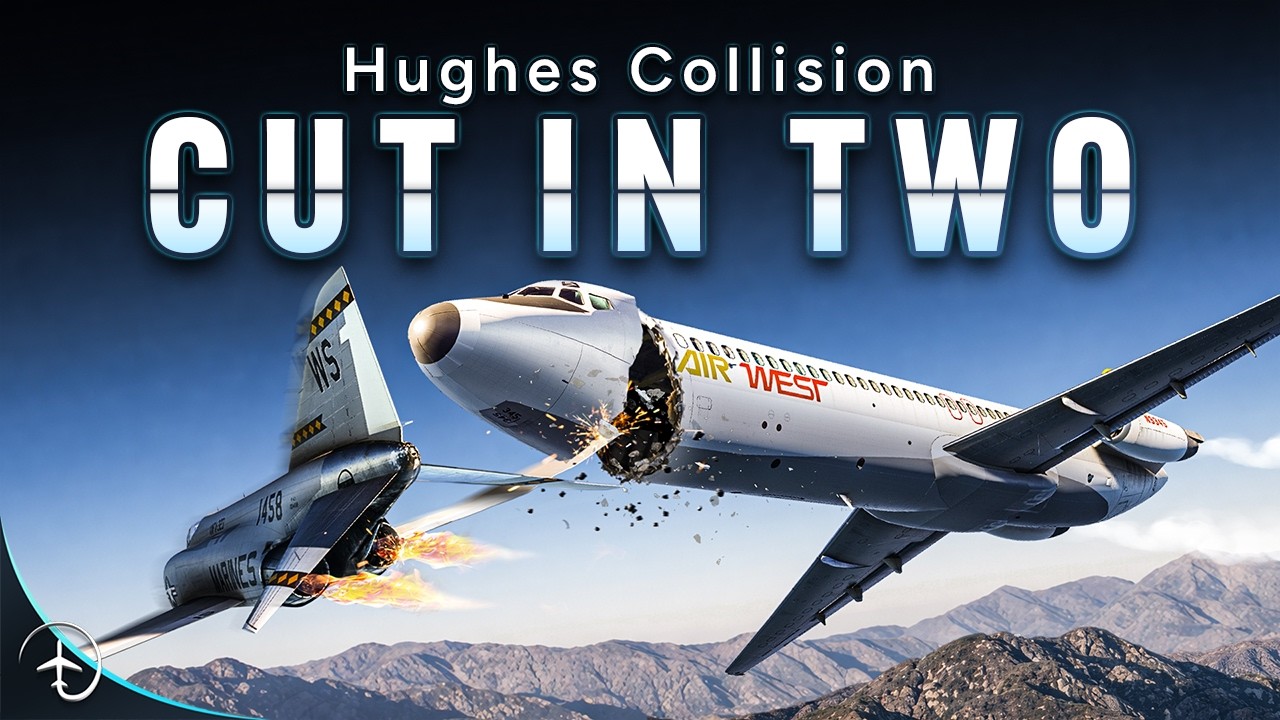
The violence of the collision was total. The Phantom's right wing carved through the lower forward fuselage of the DC-9 as far back as the tenth window row, and almost simultaneously its vertical stabiliser passed directly through the airliner's cockpit. The flight controls were severed immediately, and the forward fuselage, including the flight deck and forward galley, broke away. Witnesses on the ground reported what appeared to be an explosion, followed by debris trailing across the sky. On radar screens, the clean steady return that had been Flight 706 dissolved into incoherent fragments. The Phantom fared no better: its nose was torn apart and its right wing smashed, sending it into an uncontrolled yaw and roll from which the crew could not recover — triggering the sequence of ejection events that would claim the pilot's life through a separate, pre-existing failure.
Known F-4 Ejection Seat Flaw Trapped Phantom Pilot — Fix Was One Month Away
When the radar intercept officer initiated his ejection, the act of separating his canopy disrupted the electrical circuit that was supposed to release the pilot's canopy next. A safety interlock designed to prevent the seats from firing before the canopies cleared had the opposite effect: it locked the pilot in. This was not an unknown failure mode. The F-4B's ejection sequencing had already been identified as a design deficiency, one that made it probable — not merely possible — that a rear-seat ejection could prevent the pilot from escaping. The modification to correct it had been approved, and Phantom 458 was scheduled to receive the upgrade the following month. On June 6, 1971, it had not yet been installed, and the pilot died trapped in his cockpit when the aircraft struck the ground at the southern edge of the San Gabriel Mountains.
1971 Collision Reshaped US Airspace, Producing VFR Charts and Expanded Controlled Zones
The destruction of Hughes Airwest Flight 706 forced the FAA to confront what had been a known but unresolved overlap between high-speed instrument traffic and uncontrolled visual-flight-rules operations. The agency responded by developing terminal area charts for 22 major metropolitan regions, giving VFR pilots a published map of the departure and arrival corridors used by jet traffic — information that had previously existed only in instrument publications invisible to visual fliers. More broadly, the accident drove a restructuring of the entire US airspace architecture, expanding terminal control areas and raising the floor of mandatory radar coverage, progressively closing the intermediate band where IFR and VFR aircraft had been permitted to share airspace without positive separation.
Reforms After 1971 Crash Echo Unresolved in January 2025 Mid-Air Collision
The military reforms that followed the 1971 disaster were specific and substantive: the F-4 ejection sequencing flaw was formally classified as a design deficiency and corrected; restrictions were placed on high-speed military operations in congested airspace; and aircrews were explicitly trained to request radar monitoring from civilian controllers when flying under visual flight rules. Yet the broader structural question — whether military aircraft should be permitted to operate under different standards than civilian traffic while sharing the same sky — was never fully resolved. The January 2025 mid-air collision near Washington, and a subsequent near-miss involving an Air Force tanker, suggest that the same systemic tension identified in 1971 persists, and that the forthcoming investigation report may surface uncomfortable parallels.
Summarised from Mentour Pilot · 43:35. All credit belongs to the original creators. Streamed.News summarises publicly available video content.