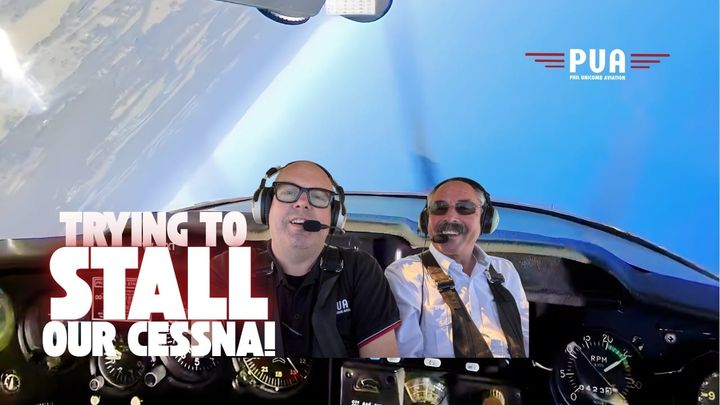
Original source: Phil Unicomb Aviation
This video from Phil Unicomb Aviation covered a lot of ground. 7 segments stood out as worth your time. Everything below links directly to the timestamp in the original video.
Understanding that yaw can come from three different sources — not just the rudder — is the critical insight most student pilots miss before an unintended spin.
Two Ingredients Required for a Spin: Stall Plus Yaw
A spin cannot develop unless two conditions exist simultaneously: a sustained stall, driven exclusively by elevator input, and sustained yaw — which can come from rudder, propeller torque, or the adverse yaw effect of ailerons. Remove either ingredient and the spin cannot establish itself.
"Will not spin unless we have a combination of two vital ingredients. One is a sustained stall. The other is sustained yaw."
Skidded Turn Stall Shows How Base-to-Final Accidents Happen
The stalling angle of attack never changes — only the elevator position determines when the wing stalls. A live demonstration in a skidded left turn shows the inside wing snapping violently, replicating exactly the conditions of a base-to-final stall-spin accident. The reaction is immediate and unforgiving.
"How would you like that turning final?"
PARE and Buller Flash: Two Emergency Spin Recovery Methods Compared
Two named emergency spin recovery procedures are in common use — the traditional PARE method, with military origins, and the Buller Flash recovery. Both address stable upright spins, the most common spin scenario encountered in training. The segment sets up live demonstrations of each technique from both left and right spin entries.
Loop Demonstration Proves Attitude and Airspeed Don't Affect Stall Onset
Stalling and unstalling through a complete loop in the Robin 2160 demonstrates a principle many pilots intellectually accept but rarely experience: attitude, G-loading, airspeed, and thrust have no effect on stall characteristics. The wing stalls at the same angle of attack regardless of the aircraft's orientation or energy state.
"Attitude, G, airspeed, thrust — don't make any difference."
PARE Spin Recovery Demonstrated Step-by-Step in Live Left Spin
Entering a stable left spin from a power-off upright stall, the PARE recovery proceeds in this sequence:
- Power: Set to idle, flaps up.
- Ailerons: Neutral.
- Rudder: Full opposite to the turn needle.
- Pause: Allow rotation to respond.
- Elevator: Progressive forward column until rotation stops, then recover from the dive.
The pause before elevator input is the step most often rushed under pressure.
"Progressive forward motion on the control column until the rotation stops."
Buller Flash Recovery Executed from Right Spin Entry
Entering a stable right spin from a power-off upright stall, the Buller Flash recovery requires only two primary inputs: release the control column entirely, then apply full opposite rudder. The deliberate simplicity — removing elevator back-pressure first — targets the sustained stall condition directly rather than fighting yaw alone.
"Power off. Release the column — pull off it rather."
CG Ahead of Centre of Pressure Explains Aircraft Self-Recovery in Buller Flash
After releasing back-pressure in the Buller Flash procedure, the control column does not simply return to neutral — it floats slightly forward of neutral, nudging the nose down without further pilot input. This self-recovery tendency occurs because the centre of gravity sits ahead of the centre of pressure, giving the aircraft an inherent pitch-down bias once elevator force is removed.
"All by itself, the airplane recovers from that very high altitude because the centre of gravity is in front of the centre of pressure."
Also mentioned in this video
- The pilot demonstrates a power-off upright stall in the Robert 2160, correcting… (0:35)
- The pilot demonstrates a stall in a higher airspeed turn, explaining the turn's… (1:23)
- The wing only stalls when the bumper position is achieved on the control… (4:18)
- The Robin 2160's engine may stop during prolonged spins due to carburetor… (5:36)
- The pilot performs another power-off upright 1G stall with elevator and rudder,… (8:57)
Summarised from Phil Unicomb Aviation · 11:00. All credit belongs to the original creators. Streamed.News summarises publicly available video content.