Original source: Phil Unicomb Aviation
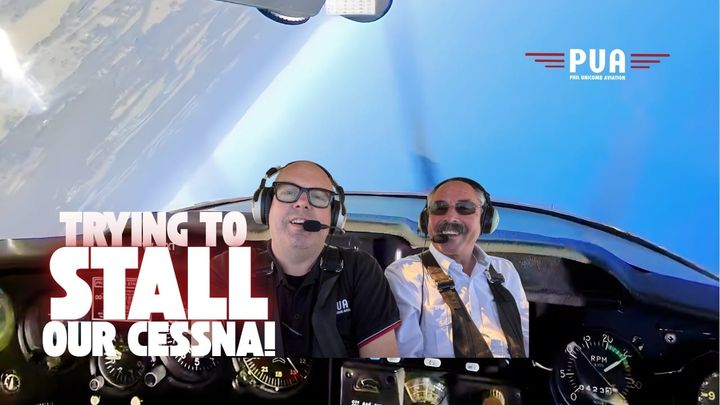
This video from Phil Unicomb Aviation covered a lot of ground. 5 segments stood out as worth your time. Everything below links directly to the timestamp in the original video.
Most pilots treat the stall warning horn as the stall itself — this demonstration shows why that assumption is both wrong and potentially dangerous.
Stall Warning Horn Confirms Nothing: The Buffet Position Is What Matters
During a power-off upright stall at 1g, the buffet — the physical shudder felt through the airframe — marks the precise point at which the wing reaches its critical angle of attack. This position on the control column is measurable as a distance in centimetres from neutral, and it is this location, not the stall warning horn, that confirms the stall threshold. The horn only signals an approaching stall, not one that has occurred.
Recovery is straightforward: move the column away from the buffet position. If altitude conservation is a priority, applying full power simultaneously allows the aircraft to fly away from the stall without significant height loss.
"The stall warning horn is just indicating that a stall is approaching — it's not indicating that a stall has occurred by any means. We need to feel the buffet."
Banked Turn Stall Test Confirms: Buffet Position Does Not Shift With Power or Airspeed
To stall at a higher power setting and airspeed without climbing, a turn is used — but the bank angle itself is explicitly irrelevant to the result. What the test demonstrates is that the buffet position on the control column appears in exactly the same location as it did in straight-and-level, power-off flight. The stalling angle of attack is a constant, and the elevator controls it; therefore the stick position at which the stall occurs cannot change simply because the aircraft is faster or the engine is producing more thrust.
The core corrective here is against a widespread misconception: pilots who "blame the bank" for a stall in a turn are misidentifying the cause. The elevator exceedance is what stalls the wing — every time.
"Please don't blame the bank. The turn itself is irrelevant — it's the only way that allows me to raise the elevator without climbing."
Stick Position Is a Distance, Not a Force — A Distinction That Changes How Pilots Train for Stalls
The stall stick position is defined by how far the control column travels in centimetres, not by how hard the pilot pulls. At slower airspeeds, controls feel less firm and less effective — a sensation pilots frequently misread as evidence that the stall is occurring at a different stick position. It is not. The elevator's angular relationship to the wing's critical angle of attack remains fixed regardless of speed, power, or attitude.
This is more about removing a deeply embedded confusion than introducing a new concept: conflating control feel with control position leads pilots to misidentify where the stall boundary actually sits.
"Remember, we're not talking about stick force. It's not how hard we pull or push. It's how far in centimetres. It's a distance, not a pressure."
Full Loop Across 360° of Pitch and 60-Knot Speed Range Produces No Stall — Until the Elevator Passes the Critical Position
Starting at 120 knots and pulling through a complete loop — descending to below 60 knots over the top — the aircraft traverses every possible pitch attitude without stalling. The stall is then triggered and released deliberately, multiple times, by moving the elevator beyond and back from the stall stick position mid-manoeuvre. Pitch attitude and airspeed prove to be spectators; only elevator exceedance of the critical angle of attack produces the stall.
What makes this demonstration so confronting is that it dismantles the intuition that unusual attitudes or low speed are themselves dangerous — the danger is always and only the elevator moving past a fixed, known position.
"I'm only going to stall in this loop if I exceed the critical angle of attack — in other words, go beyond the stall stick position."
Flaps Are the Only Variable That Shifts the Stall Stick Position — And Even Then, Only Slightly
Deploying flaps changes the chord line of the wing, effectively creating a new aerodynamic configuration with its own fixed stall stick position. A test with 20 degrees of flap shows the position moves slightly forward compared to the clean-wing reference — but the principle is unchanged: within any given flap setting, the stall stick position is constant regardless of speed, power, or attitude. The variation between clean and flapped configurations is small enough that the instructor notes it is "hardly relevant" in practice, though it must be understood.
The practical implication is that pilots need to learn one stall stick position per flap configuration — not recalibrate continuously for every flight condition.
"The stall stick position will be a constant in any given configuration. If I change the shape of the wing by taking flap, flap changes the chord line — so it's a brand new wing."
Also mentioned in this video
- The presenter demonstrates that an aerodynamic stall cannot be induced without… (0:00)
- An experiment using an angle of attack indicator to identify the buffet… (0:40)
- The absence of wing drop during a gradual stall, emphasizing that an aircraft… (3:07)
- The presenter concludes that pilots often misunderstand that a stall requires… (11:20)
Summarised from Phil Unicomb Aviation · 12:46. All credit belongs to the original creators. Streamed.News summarises publicly available video content.