Original source: Mentour Pilot
This video from Mentour Pilot covered a lot of ground. 6 segments stood out as worth your time. Everything below links directly to the timestamp in the original video.
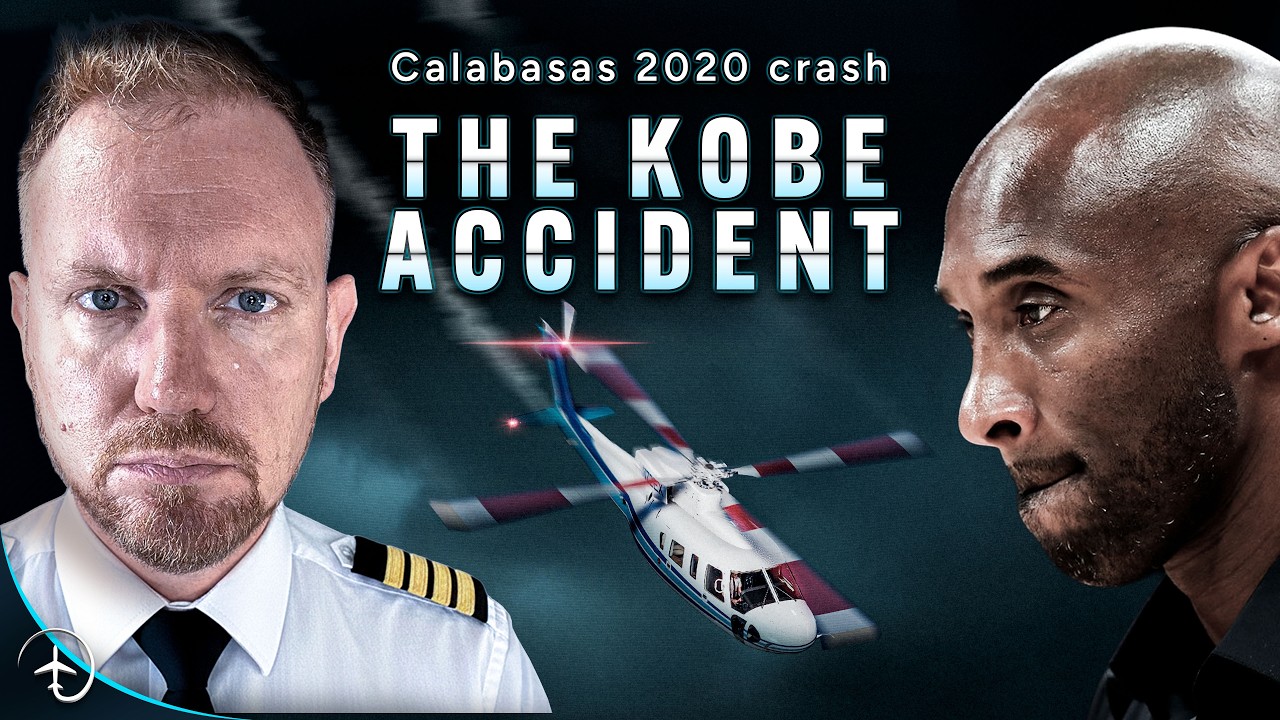
The accident that killed Kobe Bryant may have been set in motion before the helicopter ever left the ground, with a critical gap in weather awareness that investigators could never fully resolve.
Kobe Bryant Crash Pilot Likely Lacked Full Weather Picture Before Fatal Flight
On the morning of January 26, 2020, the pilot of the Sikorsky S-76 carrying Kobe Bryant planned a low-altitude VFR route from Santa Ana north through Burbank and Van Nuys airspace before turning west over the Santa Monica Mountains to Camarillo. A National Weather Service AIRMET warning was already in effect, flagging IFR conditions and mountain obscuration along that corridor. Investigators found no clear evidence the pilot received a formal pre-flight weather briefing; he may have relied instead on the ForeFlight app, which records no usage log. Both Burbank and Van Nuys were reporting cloud ceilings at 1,100 feet — nearly identical to the terrain elevation along US-101 — leaving almost no vertical margin for complying with both visual flight rules and the company's own 300-foot terrain clearance minimum.
What makes this significant is not simply that the weather was bad, but that the pilot and his company's operations director independently assessed the flight as viable, strongly suggesting neither had a complete picture of conditions in the mountains specifically — the most hazardous portion of the route.
NTSB Rules Out External Pressure in Bryant Crash, Points to Self-Induced Pilot Psychology
The National Transportation Safety Board found no evidence that anyone — the charter broker, Kobe Bryant, or his staff — pressured the pilot to fly that morning. Island Express pilots had turned down flights more than 150 times over the preceding years, including at least one occasion involving Bryant himself, and no client had ever complained about a weather cancellation. The NTSB concluded the more likely driver was self-induced pressure: the psychological compulsion pilots feel to complete a mission, rooted in professional pride and personal obligation, regardless of whether a passenger demands it. Compounding this, the pilot checked the risk analysis form for cloud ceilings below 2,000 feet but failed to check boxes for visibility under three miles — a lapse that would have triggered a requirement to draft an alternative routing plan, a plan B that was never created.
The absence of that contingency plan elevated the psychological cost of diverting mid-flight, making a continuation of the doomed route feel like the path of least resistance — a cognitive trap the industry calls plan continuation bias.
Localised Mountain Weather Phenomenon and Excessive Speed Sealed the Helicopter's Fate
Granted a special VFR clearance at 09:32 and routing north along Interstate 5 before turning west, the helicopter entered the most dangerous leg of the flight at 09:42. Witnesses along US-101 observed it travelling at what investigators confirmed was the standard cruise speed of 140 knots — a speed the FAA specifically advises against in marginal VFR conditions, where slowing down provides additional reaction time if visibility suddenly collapses. Crucially, a local meteorological phenomenon was pooling cold air in a low point along US-101 just west of Calabasas under the marine layer, creating a pocket of significantly reduced visibility that was known to meteorologists but almost certainly not to the pilot.
Flying fast into a localised weather trap with no awareness of its existence left no margin for correction — the helicopter was committed to the deteriorating corridor before the pilot could objectively assess whether conditions were still flyable.
VFR into IMC: The Leading Killer of Private Pilots and Why an Instrument Rating Is No Guarantee
VFR into IMC — a visual flight rules pilot inadvertently entering instrument meteorological conditions — is the single leading cause of fatalities among private pilots worldwide. Studies have measured the average time between entering IMC without instrument preparation and losing control or striking terrain at under three minutes, a window so short it leaves almost no margin for recovery. Nearly a third of such accidents involve pilots who hold an instrument rating, because the two prerequisites for surviving IMC are not just the rating itself but an instrument mindset and recent practical experience — neither of which the Bryant helicopter's pilot had developed, since his employer operated exclusively under VFR.
The broader implication is systemic: an instrument rating obtained in a training environment, then left unpractised in a VFR-only operation, can produce a false sense of capability that makes a pilot more, not less, likely to press on into dangerous conditions.
Radar Data Reconstructs Final Minutes of Bryant Helicopter: Spiral Descent After Vestibular Illusions Overwhelmed Pilot
Within two seconds of witnesses watching the helicopter disappear into what one described as a wall of cloud, the pilot called the TRACON controller to report IMC — the precise opposite of what Island Express emergency procedures required. Those procedures mandated that the pilot first stabilise the aircraft on the attitude indicator, establish a climb at 75–80 knots with 70–75% torque, engage the autopilot, and only then declare an emergency. Instead, he attempted to climb and communicate simultaneously, and when the controller — a shift replacement unfamiliar with the flight — instructed him to press the transponder ident button for radar identification, the pilot's attention broke from the instruments. Radar data shows the helicopter peaked at 2,370 feet before entering a tightening left spiral. The investigation concluded he was experiencing both the somatogravic illusion, which caused the vestibular system to interpret forward acceleration as a nose-up climb, and the leans illusion, which led him to bank further into the turn in an attempt to feel level. A witness on a bike trail near US-101 saw the aircraft descend from the clouds at high speed before it struck the mountain. All nine occupants, including Kobe Bryant and his daughter, died on impact.
This was not a single failure — it was a chain of events in which every intervention arrived too late, too fragmented, or was actively undermined by the physiological inevitability of spatial disorientation under extreme stress.
NTSB Cites Plan Continuation Bias and Systemic Safety Failures in Bryant Crash Finding
The National Transportation Safety Board determined that the accident's probable cause was the pilot's decision to continue VFR flight into deteriorating conditions until he lost all visual references, with plan continuation bias and self-induced pressure identified as contributing factors. Investigators acknowledged that Island Express had gone beyond regulatory requirements in adopting a safety management system, but concluded the system had failed to detect that pilots were routinely not completing risk management forms correctly for marginal weather flights — a gap that rendered the paperwork largely ineffective.
The NTSB framed the crash as an instance of a far wider problem: VFR into IMC accidents have claimed pilots at every level of experience, from private aviators to professional operators, among them other public figures including Buddy Holly. The board's recommendation to all pilots flying under VFR is to establish firm, pre-committed personal minimums for visibility and cloud ceiling, and to turn back or land immediately when those thresholds are approached.
Summarised from Mentour Pilot · 38:03. All credit belongs to the original creators. Streamed.News summarises publicly available video content.