Original source: Phil Unicomb Aviation
This video from Phil Unicomb Aviation covered a lot of ground. 3 segments stood out as worth your time. Everything below links directly to the timestamp in the original video.
A common belief among pilots — that steep banks increase stall risk on their own — is put to a direct flight test here, with results that challenge standard intuitions about what actually causes a stall.
Flight Instructor Demonstrates That Bank Angle Alone Cannot Cause an Aerodynamic Stall
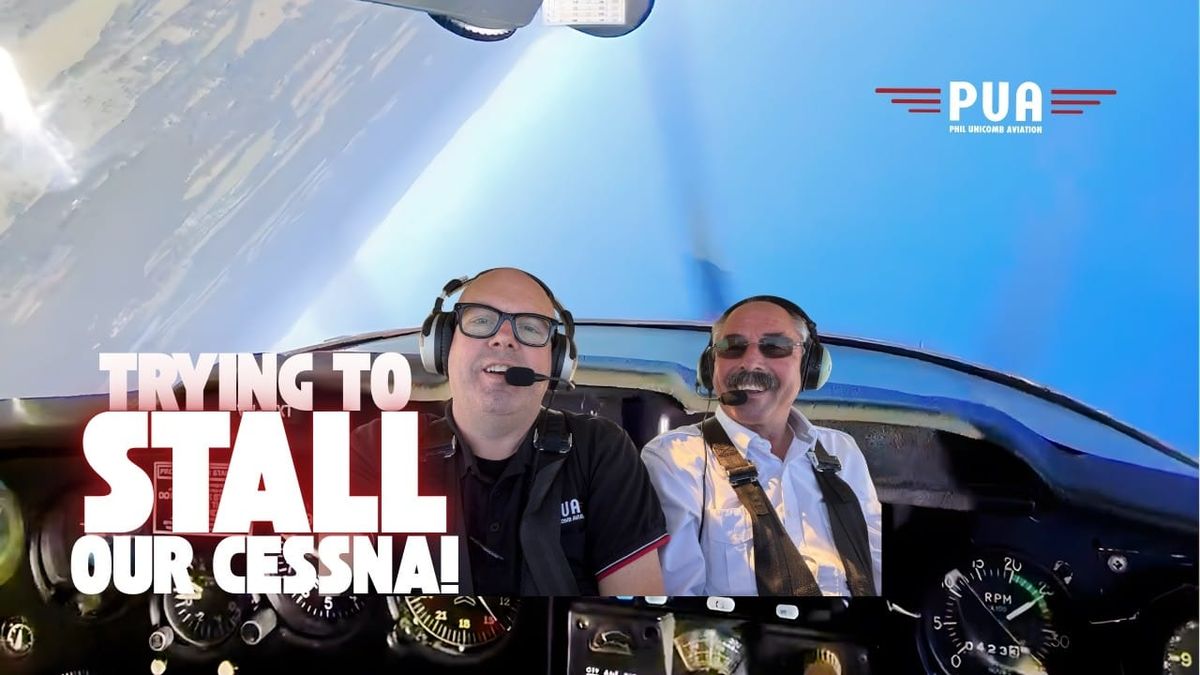
Pilot and instructor Phil Unicomb performed a maximum-angle 360-degree steep turn with zero elevator input to prove that bank angle cannot trigger a stall. His argument: only the elevator can increase load factor — the multiplied gravitational force on an airframe — and without load factor increase, the wing cannot be pushed past its stalling angle of attack. The aircraft completed the full turn without stalling, making the point concrete and repeatable.
Many pilots instinctively associate steep banks with stall risk, a belief that shapes how they fly traffic patterns and emergency turns. If the instinct is wrong, it has real implications for how stall-awareness training is taught and tested.
"If bank could make a stall, what I just did then would be impossible."
Flaps Without Elevator Input Trigger Stall Warnings But Not a Sustained Stall, Demonstration Shows
Deploying flaps in stages — 10, 20, then 40 degrees — without touching the elevator column triggered stall warnings and pitch oscillations, but the aircraft recovered on its own each time. Unicomb's point is that an aircraft's inherent pitch stability continuously works to restore equilibrium, and only sustained back-pressure on the elevator column could lock the wing in a stalled state.
This matters because 'flap-induced stall' is a scenario pilots are warned about in training. The demonstration suggests the real danger is the pilot's elevator response to the pitch change flaps produce, not the flaps themselves.
"The only way that I could cause that to stay stalled would be if I kept moving the column back towards me."
Wing-Over Maneuver With 90-Degree Bank and Zero Airspeed Reading Fails to Produce a Stall
To simultaneously test every factor pilots commonly blame for stalls — attitude, bank, and low airspeed — Unicomb flew a wing-over with a nose attitude of 60 to 70 degrees above the horizon, 90 degrees of bank at the apex, the aircraft out of aerodynamic balance, and airspeed so low it fell off the instrument scale. No elevator was used throughout. The aircraft recovered unassisted, pulled back toward stable flight by its own pitch stability.
The sequence consolidates the series' central argument: stalls are caused by elevator-induced load factor, not by any combination of the variables pilots are most often taught to fear.
"People want to blame airspeed, attitude, and bank — and it just recovered itself."
Also mentioned in this video
- The presenter demonstrates that reducing thrust from straight and level flight… (0:00)
- The presenter demonstrates that crossing controls with no elevator input,… (0:32)
- Side slipping, by applying full rudder at low power and airspeed without… (1:05)
- Turbulence as a transient event that will not cause a sustained stall. (4:50)
Summarised from Phil Unicomb Aviation · 5:59. All credit belongs to the original creators. Streamed.News summarises publicly available video content.