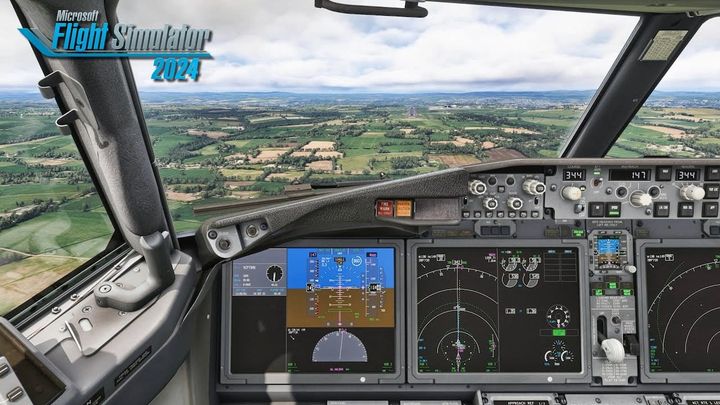
Original source: 320 Sim Pilot
This video from 320 Sim Pilot covered a lot of ground. 15 segments stood out as worth your time. Everything below links directly to the timestamp in the original video.
GPS jamming is now common enough that airline crews are reviving 1970s navigation techniques. Understanding how INS and DME triangulation work explains why modern airliners carry multiple overlapping systems and why none of them ever truly became obsolete.
How Aircraft Navigate Without GPS: INS, DME Triangulation, and the Return of Radio Nav
With GPS jamming now a routine hazard on routes across multiple regions, the layered navigation architecture of modern airliners has taken on renewed importance. Inertial Reference Systems — arrays of gyroscopes that track acceleration from a known starting point and require no external signal — formed the sole trans-oceanic navigation tool for aircraft like the 747-200 before GPS existed, with aircraft flying the North Atlantic under wider separation standards precisely because INS drift could accumulate to a couple of miles over the crossing. When within range of land-based stations, crews would update that position using two DME readings simultaneously: tuning one station to 111.2 MHz and a second to 108.6 MHz, then intersecting the two distance circles on a chart to fix the aircraft's position with considerably greater accuracy than a single bearing.
Modern FMS computers perform this dual-DME triangulation automatically, and on aircraft such as the 777 the GPS can be disabled entirely while radio updating takes over seamlessly. What makes this particularly significant is the direction of travel: capabilities that were considered legacy procedures are quietly becoming operational doctrine again, as spoofing and jamming events render the primary satellite signal untrustworthy across increasingly large portions of the globe.
"These days we're coming back to that system as GPS gets switched off — luckily, not switched off, but jammed."
▶ Watch this segment — 2:36:51
EFB Performance Calculator Produces Takeoff Speeds and Pitch Target for 747-200 Departure
Using the aircraft's electronic flight bag performance calculator, the correct takeoff parameters for runway 26 Left are determined in a single workflow.
- Load aircraft data: Select 'load from sim' to import the current weight — 276 tonnes — rather than the load sheet.
- Enter environmental conditions: Input runway length 2,600 m, field elevation 100 ft, ambient temperature 17°C, and surface condition dry.
- Confirm flap setting: The calculator returns Flap 10 (flat 10) as the optimal configuration given the aircraft is well below its 360-tonne maximum.
- Read and set V-speeds: V1 = 132 kt, VR = 141 kt, V2 = 155 kt; set speed bugs accordingly, with the orange bug marking V2 at 155 kt and the flaps-up speed noted at 228 kt.
- Set flight director pitch: Dial in 16° as the initial pitch target on the flight director — a manual step that advanced fly-by-wire aircraft handle automatically.
- Record stabiliser trim: Note the computed trim setting of 4.3 before engine start.
On aircraft with fully integrated flight management, these inputs calculate automatically at engine start; on older types, omitting any step creates an unchecked assumption that can compromise the departure.
"You don't see this sort of thing anymore — obviously the airplanes will have very advanced flight director systems, so you don't have to mess this up."
747-200 Takeoff Sequence: EPR Auto-Throttle to INS Nav Mode and Flap Retraction Schedule
The departure from runway 26 Left demonstrates the full takeoff sequence unique to an older, analogue-era heavy jet.
- Stabilise engines: Advance throttles manually to approximately 1.1 EPR, confirm 'stabilised' indication, then release brakes.
- Engage auto-throttle: Select EPR mode; the system drives throttles forward to the computed takeoff thrust setting.
- Rotate: At V1 and VR (141 kt), apply smooth back pressure to 16° pitch as indicated by the flight director; hold rudder to counter crosswind from the right.
- Gear up: Select gear retraction immediately after positive rate of climb is confirmed.
- Activate INS navigation: At 1,500 ft, engage INS mode so the flight director begins tracking the planned waypoint sequence.
- Retract flaps on schedule: Reduce from Flap 10 to Flap 5 at 168 kt, then fully up at 228 kt; lower pitch to approximately 10° during acceleration.
- Configure for climb: Select nav and IAS modes; set auto-throttle to climb EPR to derate from takeoff thrust.
The absence of automated flap retraction scheduling — standard on modern fly-by-wire types — means any distraction during acceleration risks holding flaps into the clean-speed regime and overloading the structure.
"Pitching up to our 16-degree flight director — and we're away."
▶ Watch this segment — 1:07:09
Clock Jumps and Vanishing Position Data: How Crews Detect GPS Jamming and Spoofing
GPS jamming presents an insidious problem because its earliest symptoms are easy to attribute to minor system glitches. The first indicator is typically the aircraft clock: because modern avionics derive their time reference from the GPS signal — which is, at its core, a precision time-broadcast system — a jammed or spoofed signal causes the clock to jump discontinuously, for example from 18:13 to 18:20 in an instant. The ADS-B transponder, which relies on GPS for position broadcasts, is also disrupted early. More seriously, spoofing — where the receiver continues to show a GPS position that is simply false — is harder to detect than outright jamming; cross-checking against the FMS position, the INS position, and radio-derived position simultaneously is the primary defence. The Ground Proximity Warning System can generate spurious pull-up alerts because certain terrain-awareness modes use GPS to cross-reference the aircraft's location against a digital terrain database. Critically, TCAS is entirely unaffected, as it operates on transponder-to-transponder ranging and requires no GPS input.
Earlier INS technology on aircraft like the 747-200 drifted as much as two to four nautical miles between gate alignment and cruise altitude, a rate crews corrected through airborne DME updates at oceanic entry and exit points. Modern ring-laser and solid-state gyro IRS units drift far more slowly, which is precisely why airlines never abandoned them — and why that decision now looks prescient.
"The big one is the clock — you'll see the clock can even jump, so it goes to 18:13 and then it would just say 18:20, and if you weren't looking at it when it changed, you wouldn't notice."
▶ Watch this segment — 2:42:29
APU Startup and Electrical Transfer: The First Steps in Bringing a 747-200 to Life
Transitioning a parked 747-200 from ground power to self-generated electrical power follows a precise sequence before IRS alignment can begin.
- Arm emergency lights: Set the emergency lighting switch to armed so passenger escape path lighting activates automatically in the event of a power interruption.
- Open the APU master switch: Place the APU master to 'on' and wait for the APU inlet door to fully open — confirmed by animation — before proceeding.
- Start the APU: Select 'start'; the auxiliary power unit reaches operating speed rapidly and provides bleed air pressure to the pneumatic system.
- Provide bleed air: Enable bleed air output to build pressure in the distribution manifold, supporting subsequent systems; hold off air conditioning packs for now.
- Transfer electrical power: Close the APU generator circuit breakers — one at a time — to connect APU power to the busses; the external ground power contactors trip open automatically, confirming the transfer is complete.
This sequence — establishing self-generated power before IRS alignment — is essential because the IRS requires a stable, uninterrupted power supply throughout its alignment period; a power source changeover mid-alignment forces a full restart.
"You're closing the circuit — close that, close that, close that, close that — and now it's tripped off from the external power."
Before-Start Checklist: IRS Alignment and Cockpit Verification on the 747-200
With the EFB's quick IRS align function invoked to expedite gyroscope alignment, the before-start checklist proceeds through the cockpit in a structured, audio-interactive sequence.
- IRS quick align: Access the EFB options menu and select 'INS quick align' to accelerate the normal eight-to-seventeen-minute alignment process.
- Gear lever and lights: Confirm gear lever down and indicator lights checked.
- Brakes: Parking brake set.
- Start levers: Confirm all four in the off position.
- Radios: Verify all communication and navigation radios are powered and set.
- Flight controls: Confirm hydraulic power and flight control drive switches are all on.
- INS: Verify all three INS units are in 'NAV' mode.
- Window heat, seat belts, emergency lights: Confirm window heat on, seat belt and no-smoking signs on, emergency lights armed.
- Flight instruments and altimeters: Cross-check altimeter settings — 1013 set and confirmed — against both sides.
- Radio/INS switches: Set navigation source selectors to radio.
The interactive audio callout system catches any item not completed before moving to the next, providing an effective human–system cross-check that is particularly valuable on a type where one crew member must cover both pilot and engineer positions.
"It's such a great system — a huge checklist, and it's interactive."
Sequential Engine Start: Why the 747-200 Cannot Start Two Engines Simultaneously
The 747-200 engine start sequence — engines 4, 3, 2, then 1 — is determined by pneumatic duct pressure limitations, not crew preference. The aircraft's APU, less powerful than the unit fitted to the 747-400 series, cannot sustain sufficient bleed air pressure to spin two high-pressure compressors simultaneously; attempting to do so causes the duct pressure to collapse and the N2 spool to stall before reaching the 20% threshold at which fuel can be safely introduced. Each engine is started individually: the start valve is armed, ground start is selected and held until 'valve open' is confirmed, N2 is monitored climbing through 17, 18, 19, 20%, and only at that point is the fuel lever advanced to idle. The starter cuts out automatically once the engine accelerates to self-sustaining speed.
What makes this procedurally significant is the discipline around the 20% N2 gate. Introducing fuel below that threshold risks a hung start — combustion that cannot sustain itself — or a hot start, where exhaust gas temperature spikes beyond limits before the compressor is moving fast enough to cool the combustion section. On a four-engine aircraft, an engine damaged during start is an expensive and potentially runway-closing event.
"What happens is your duct pressure just drops and then your N2 does not accelerate — that's how I know it won't work."
Cruise Fuel Management on the 747-200: EPR Limiting, Pack Configuration, and Tank-to-Engine Switching
Reaching cruise altitude on the 747-200 triggers a sequence of manual fuel and environmental control actions that are fully automated on modern types. The EPR limiter is moved from takeoff to cruise setting, reducing the maximum engine pressure ratio available and protecting the engines from over-boost at altitude. Air conditioning pack flow is then configured according to passenger load: with a full cabin, packs one and three run at full flow while pack two operates at half — a balance that optimises humidity and air distribution. Fuel management requires close adherence to a written procedure: once the main tanks two and three quantities exceed the combined quantity in tanks one and four plus reserves, crossfeed valves four and one are closed, placing each engine on its own tank feed. A critical threshold governs the reserve tanks — when main tank one or four drops to 2.3 tonnes, the reserve valves must be opened to allow that fuel into the feed system before it is stranded.
The investigation into why such granular manual management survived so long on this airframe is answered by contrast: the A320 manages outer tank transfer automatically, and the 787 adjusts pack flow the moment a passenger count is entered into a cabin management screen. On the 747-200, every one of these steps is a potential omission.
"All of this is automated — even the A320 does have these sort of outer tanks, but it does that automatically."
▶ Watch this segment — 1:36:20
Final Approach Configuration on the 747-200: Flap Sequence, Autobrake, and Landing Checklist
Intercepting the glideslope for runway 25 Left at Los Angeles triggers a compressed configuration sequence that must be completed before the aircraft descends through decision height.
- Set go-around altitude: Enter 2,000 ft in the altitude window before glideslope capture — the legal minimum required for any missed approach on this procedure.
- Deploy Flap 20: Select as speed permits on glideslope intercept; with 18 knots on the glideslope, Flap 10 is generating useful drag.
- Arm speed brakes: Confirm the spoiler lever is in the armed position so ground spoilers deploy automatically at touchdown.
- Extend gear: Gear down, three green lights confirmed; note that the 747 body gear tilt mechanism repositions the rear axle to the landing attitude — visible in the gear indicator.
- Select Flap 30: Advance to landing flap; Vref for Flap 30 is 136 kt, giving a target approach speed of 141 kt.
- Set autobrake to minimum: Sufficient for a long runway with good conditions.
- Complete landing checklist: Gear down and checked, flaps 30 confirmed, spoilers armed, ignition to flight start, altimeters set and cross-checked.
The DME colocation offset — common at US airports, where the DME is sited two miles from the threshold — means the crew is effectively two miles closer to touchdown than the raw readout suggests, a detail requiring active mental correction during spacing assessment.
"Remember, this is America — so I bet that DME is not co-located. It's going to be two miles out, so we're actually eleven miles from touchdown."
▶ Watch this segment — 4:06:53
Manual Landing at Los Angeles: Autopilot Disconnect, Flare Technique, and High-Deck Taxiing Challenges
The manual landing at Los Angeles demonstrates several handling characteristics specific to the 747's size and deck height. Autopilot is disconnected with three white lights showing on the approach director indicator — approximately 300 ft above the threshold — with thrust held at 1.07 EPR to maintain the target approach speed with a small margin above Vref. At 30 ft radio altitude, throttles are retarded to idle and the flare is initiated; at touchdown, reverse thrust is selected immediately and the autobrake system absorbs the deceleration load, with idle reverse maintained through the runway exit at 90 kt. The aircraft vacates at the first available taxiway and crosses runway 25 Right before calling clear.
What makes this phase particularly instructive is the observation on high-deck handling: the flight deck sits well above the runway surface, which compresses the visual perspective during the flare and makes judging the moment of ground contact less intuitive than on a narrow-body. The aircraft's large fuselage also creates significant lateral sensitivity in crosswind conditions on the ground roll, requiring active rudder correction even at moderate wind speeds — a characteristic that diminishes as speed decays but demands attention precisely when workload is highest.
"It is sensitive to the wind, this airplane — I suppose it has a big side to it, so it makes sense."
▶ Watch this segment — 4:12:50
Before-Start Checklist: Systems Verification from Radar to Oxygen Mask on the 747-200
The second half of the before-start checklist covers the aircraft's protective and warning systems, each requiring physical confirmation rather than a visual scan.
- Radar: Set to standby.
- Transponder: Confirm in 'lights check' mode.
- Engine and wing anti-ice: Confirm off for departure in current conditions.
- Stall warning: Test the stall warning system; the audio-interactive checklist confirms the test has been completed.
- Mach/airspeed warning: Test and confirm — the system recognises a completed test automatically.
- Body gear steering: Arm the body gear steering switch — a manual step on the 747-200 that is fully automatic on the 777.
- Anti-skid: Confirm on.
- Autopilot and flight director: Confirm check and off for departure.
- Takeoff warning: Test by advancing throttles briefly; the horn confirms the system is armed.
- GPWS: Complete the ground proximity warning system test.
- Instrument warning: Activate the instrument warning test, illuminating all warning annunciators simultaneously to confirm bulb serviceability.
- Oxygen mask and regulator: Confirm check and emergency off.
The body gear steering step is operationally significant: failure to arm it before a turn onto a short taxiway risks the main gear body assembly tracking outside the turn radius, with potentially serious consequences for pavement clearance.
"Body gear steering — that's automatic on the 777, but on the 747-200 you have to arm it."
Stabiliser Trim and EPR Computer: Resolving Pre-Start Configuration on the 747-200
Two system-specific requirements on the 747-200 reveal the interdependence between hydraulic pressure, mechanical trim, and engine management that later generations of aircraft resolved through automation. The stabiliser trim cannot be set to the computed value of 4.3 units until the hydraulic system is fully pressurised; the alternate trim lever, which bypasses the primary drive, similarly requires hydraulic pressure to actuate. The resolution is to pressurise all hydraulic circuits before attempting trim adjustment — a sequencing dependency that is not immediately obvious and causes the checklist to stall until it is addressed. Separately, the auto-throttle computer must be configured to TOGA and EPR mode before engine start, establishing the thrust management logic that will govern the entire departure phase. The flight engineer's panel checklist then confirms bleed valve positions — essential for engine starting — and EPR computer mode, which is set to go-around until the takeoff phase requires it to advance to TOGA.
The investigation into stabiliser trim failures on earlier-generation jets consistently highlighted the gap between what a crew assumed was set and what was mechanically confirmed. The 747-200's reliance on hydraulic pressure to move trim makes that assumption potentially dangerous if pre-start sequencing is rushed.
"Just not enough pressure in the system — once you pressurise it, now it runs."
After-Start Checklist: Flap Deployment, Flight Controls Check, and Transponder Activation
Completing the after-start sequence on the 747-200 brings together several panels that, on modern aircraft, are managed by centralised automated systems.
- APU shutdown: Turn off the APU now that all four engines are providing bleed air and electrical power.
- Engine anti-ice: Confirm off for prevailing conditions.
- Flaps to 10: Select takeoff flap setting; confirm travel on the indicator and cross-check with the takeoff data card.
- Transponder: Set from standby to the assigned squawk code.
- Flight controls check: Using the dedicated dial on the first officer's side panel, exercise full aileron, elevator, and rudder deflection slowly and smoothly; confirm both panels of each surface move correctly, reflecting the separate hydraulic feeds to upper and lower elevator and to the split rudder sections.
- Run after-start checklist: The interactive system confirms split system breaker closed, start switches off, beacon lights on, start levers at idle detent, engine anti-ice off, electrical panel set, pack valves open, and hydraulic panel checked.
The divided hydraulic architecture on the flight controls — two separate panels for the elevator, two for the rudder — is a design characteristic that later Boeing aircraft consolidated into single-surface assemblies fed by redundant systems, simplifying the visual check while preserving the underlying redundancy.
"You've got loads of moving bits in this airplane — divided up, so you've got two separate panels there on the elevator, same on the rudder."
Weight, Balance, and the Consequences of Cargo Shift: How Load Controllers Keep Airliners Flyable
Weight and balance is simultaneously one of the most rigorously engineered disciplines in aviation and one of the most invisible to passengers. Load controllers work within two distinct limits: a structural maximum — the weight beyond which airframe fatigue and landing gear loading become unsafe — and a performance maximum, which is more restrictive on hot days or from high-elevation airports where engine and wing performance cannot guarantee climb. Balance is the more aerodynamically consequential variable. A nose-heavy aircraft requires higher speeds to rotate and burns additional fuel fighting the corrective download the tail must generate. A tail-heavy aircraft is more dangerous: elevator authority is limited by the aerodynamic power available in the tailplane, and if cargo shifts rearward in flight — as occurred in a crash cited during the discussion, where a military vehicle broke free and rolled aft — the nose pitches irrecoverably upward and speed decays to the point where the wings produce no lift.
A less obvious performance benefit of an aft centre of gravity emerges on the 777-200: with the CG positioned sufficiently far aft within limits, the tailplane's download requirement reduces, decreasing induced drag and allowing a small increase in maximum takeoff weight — a factor load controllers on performance-limited sectors actively target.
"It's very possible to make this airplane unflayable — and sadly, there is a shocking video of one that did exactly that, where all the weight shifts to the back and then it's unflyable."
▶ Watch this segment — 3:25:34
Recovering a Missed Arrival: Orbit, FMS Hold, and Approach Checklist Completion
Overflying the arrival fix — a situational awareness failure prompted by extended discussion during cruise — requires an immediate recovery that exercises several autopilot and FMS functions simultaneously. Heading mode is selected and a left orbit initiated, with 17,000 ft set in the altitude window as a terrain-safe capture level. The auto-throttle is disconnected by selecting IAS mode and throttles are brought to idle, while vertical speed mode at 1,000 ft per minute with speed brakes deployed begins the energy reduction. The more elegant solution, identified mid-orbit, is to use the FMS hold function at the missed fix: selecting the hold at the waypoint with a 10-mile leg and left turns places the aircraft in a structured pattern rather than a raw orbit, and re-engaging INS navigation restores full FMS guidance. The approach checklist then runs in parallel with the descent: radio/INS switches to radio, altimeters cross-checked at 1013, EPR computer set to go-around, fuel heat off, and approach speeds and bugs confirmed.
What makes this sequence instructive beyond the immediate recovery is the transparency of the situational awareness failure itself. The top-of-descent marker and associated FMS cues that would have prompted the descent on a modern glass-cockpit aircraft were absent or not cross-monitored, and the workload of the live stream environment substituted for the kind of heads-down distraction that causes identical errors in line operations.
"In all that talking, what I managed to do is fly straight through our arrival — it shows you the situational awareness given to us by computer screens, the top-of-descent markers — these subtle cues that were missing."
▶ Watch this segment — 3:48:24
Also mentioned in this video
- The flight plan from Houston to Los Angeles, discussing the choice of XPlane 12… (8:53)
- The pilot begins the cold and dark startup procedure for the three-crew… (13:08)
- The presenter initiates the aircraft power-up using the EFB's checklist feature… (14:18)
- The presenter checks battery power, standby power, and reviews the complicated,… (15:24)
- The presenter details various cockpit panels, including electricity, APU, air… (16:11)
- The compact flight deck of the 747 compared to the 777. (20:30)
- The presenter activates the zone one research fan, adjusts cabin airflow, sets… (21:26)
- The presenter reviews the overhead panel, checking flight controls, emergency… (23:40)
- The presenter begins inputting the flight plan into the FMS, specifying the… (30:37)
- The presenter refines the flight plan for an arrival into LAX, selects runway… (33:10)
- The presenter prepares for pushback, disconnecting ground services, arming… (38:40)
- The presenter sets the initial climb altitude to 16,000 feet, configures the… (41:11)
- The cabin and passenger capacity of the 747-200, and proceeds with disarming… (53:50)
- The presenter announces the taxi route to runway 26 left, activates turn-off… (1:00:16)
- The presenter continues taxiing, highlighting the aircraft's responsive ground… (1:01:18)
- The challenges of XPlane 12 graphics versus Microsoft Flight Simulator, and… (1:13:06)
- Historical navigation practices without FMS, and highlights XPlane 12's… (1:16:30)
- The presenter turns off landing and logo lights, activates the seatbelt and no… (1:19:08)
- The visual design of the A350, comparing it to older aircraft, and answers… (1:27:07)
- The importance of arming 'outsel' for altitude hold, and discusses career… (1:32:20)
- The delayed 777X, comparing its potential features to the 787, addresses pilot… (1:33:51)
- The presenter offers detailed career advice for aspiring pilots, emphasizing… (1:42:02)
- The delayed 777X, its potential features, and the importance of cabin humidity,… (1:45:10)
- The 747's high fuel consumption at maximum speed, adjusts speed to conserve… (1:53:35)
- The presence of other VATSIM traffic, and examines the autopilot's interface… (1:59:50)
- The rarity of flight simulation among real-world pilots, the challenges of… (2:02:49)
- The historical reasons for the 747's distinctive hump design. (2:09:19)
- A comment about not using the INS, explaining the practical reasons for using… (2:15:04)
- The 747's cargo capabilities, the dynamics of who lands the aircraft on… (2:20:25)
- Managing jet lag on long-haul flights, emphasizing the importance of sleep and… (2:24:26)
- The presenter expresses satisfaction with the 747 add-on's realism and ease of… (2:49:12)
- Specific features of the flight engineer's panel, such as engine vibration… (2:51:50)
- The potential for a 737 Max tutorial, acknowledges fuel freezing issues in… (3:00:52)
- Modern aircraft like the 777 and 787 use advanced flight controls to manage… (3:07:56)
- The presenter prepares for descent and arrival into LAX, setting up the FMS for… (3:13:00)
- Alternative radar navigation approaches for LAX, and explains the general… (3:16:51)
- The basic principles of lift and aerodynamics, including Venturi effect, center… (3:39:58)
- The presenter continues the descent to 12,000 feet, tunes the altimeter,… (3:56:06)
- The presenter taxis to a stand next to a British Airways 777, performs the… (4:16:32)
- The presenter uses XPlane's replay system to review the landing, highlighting… (4:22:16)
Summarised from 320 Sim Pilot · 4:29:56. All credit belongs to the original creators. Streamed.News summarises publicly available video content.