Original source: Mentour Pilot
This video from Mentour Pilot covered a lot of ground. 8 segments stood out as worth your time. Everything below links directly to the timestamp in the original video.
A routine pre-approach checklist takes minutes to complete. Skipping it on Flight 771 started a cascade that killed 103 people.
Skipped Approach Briefing Set Fatal Chain in Motion on Afriqiyah Flight 771
The crew of Afriqiyah Airways Flight 771 began their descent toward Runway 09 at Tripoli without conducting the thorough approach briefing that standard operating procedures required. Only when the aircraft was already close to the final approach point did the first officer deliver a compressed, improvised summary — one that omitted any discussion of which automation modes would be used or how the approach would be structured. That single procedural gap meant neither pilot had a shared mental model of what was supposed to happen next.
What makes this particularly significant is that the briefing is not bureaucratic box-ticking — it is the mechanism by which a crew establishes a common reference against which any deviation becomes immediately visible. Strip it away, and the flight becomes entirely dependent on everything unfolding exactly as each pilot privately assumes it will.
"Each omitted detail removes a safety margin and makes the flight more dependent on everything unfolding exactly as the pilots expect it to do — which it rarely does."
Ambiguous Cockpit Communication Left Flight 771 Crew with Conflicting Plans
As Flight 771 turned onto the final approach track, the absence of a formal briefing produced its first direct consequence: the captain and first officer were no longer operating from the same plan. The captain's vague, non-standard calls — including a reference to a 'nav approach' and a separate call of 'Track FPA' — were open to contradictory interpretations, and the first officer began to doubt whether the captain still intended a fully managed, automated descent or wanted him to switch to manually selected modes. In a functioning cockpit, a completed briefing would have made any such ambiguity impossible.
This divergence in situational awareness, invisible and unresolved, would compound every subsequent decision both men made on the approach.
First Officer's Premature Descent Input Began Flight 771's Fatally Low Profile
Still uncertain about his captain's intentions, the first officer armed the approach mode for a managed descent and verified it on the flight mode annunciator — the correct action. But moments later, at 03:59:24, a flight path angle of minus three degrees was manually selected on the flight control unit, overriding the armed mode and starting the final descent before the aircraft had reached the Tango Whiskey locator, the designated starting point. The most likely explanation is that the first officer misread the distance to the runway — 5.2 nautical miles — as the distance to Tango Whiskey, triggering the descent roughly one nautical mile too early.
That early start, unnoticed by either pilot, placed the aircraft on a trajectory that would carry it below the minimum safe crossing altitude before anyone realised what had happened.
Distracted Captain Failed to Notice Flight 771 Crossing Final Beacon Far Below Safe Altitude
As Flight 771 crossed the Tango Whiskey beacon — the final approach fix — it was already significantly below the minimum crossing altitude of 1,350 feet, a deviation that went undetected by the captain, the first officer, and a relief pilot also present on the flight deck. The captain was simultaneously occupied with an air traffic control exchange and a personal radio call from a colleague who had just landed and was warning him that the actual visibility was far worse than reported. Neither distraction absolved him of his monitoring duties, but together they effectively pulled his attention away from the instruments at the critical moment.
The fact that three qualified crew members on the flight deck failed to detect or challenge a dangerously low crossing altitude illustrates precisely why standard call-outs and cross-monitoring exist — and what happens when both silently lapse at once.
Flight 771 Crew Had Botched the Same Approach Weeks Earlier — and Filed No Report
When the Enhanced Ground Proximity Warning System finally called out 'Too low, terrain,' the captain ordered a go-around and the first officer responded correctly, disconnecting the autopilot and advancing the thrust levers. What the investigation later revealed, however, was that this was not the crew's first encounter with a dangerously unstable approach on the same route. Just weeks earlier, on April 28th, the same two pilots had flown an almost identical approach in similarly marginal visibility, drifted below their intended vertical profile, executed a go-around, and accidentally triggered an overspeed warning in the process. Crucially, they never filed a report.
In aviation, an unreported near-miss does not simply disappear — it quietly reshapes a crew's sense of what is acceptable, while denying the airline any chance to intervene before the same pattern repeats with fatal consequences.
"Near misses and mistakes are often useful safety events, but only if they are recognised as such and debriefed in a structured way."
Somatogravic Illusion Caused Flight 771's First Officer to Push Aircraft into Ground During Go-Around
Having correctly initiated the go-around — advancing thrust, pitching up and calling for flap retraction — the first officer began to succumb to somatogravic illusion, a perceptual trap in which the powerful acceleration of full thrust, combined with an existing nose-high attitude and no visual horizon, causes the brain to interpret acceleration as excessive pitch-up. Rather than climbing away, the first officer began pushing the sidestick forward, transitioning the aircraft from an initial pitch angle of nearly fifteen degrees nose-up to a negative 3.5 degrees — pointing it back toward the ground. The captain, startled by the terrain warning that had triggered the go-around call, failed to issue the standard monitoring calls that might have prompted the first officer to verify his instruments.
What makes this particularly significant is that somatogravic illusion is well-documented and specifically trained against — yet it remains lethal precisely when crews are most distracted and least likely to cross-check their instruments.
Both Pilots Gripped by Illusion as Captain Called Air Traffic Control Instead of Recovering Aircraft
Rather than arresting the pitch-down descent, the captain was himself making forward inputs on his sidestick — inputs that mirrored the first officer's closely enough that the Airbus dual-input warning never triggered. Instead of focusing on the aircraft's worsening attitude, he first retracted the flaps on request, then reached for the speed selector to command the autothrottle to reduce thrust — a manoeuvre that was both futile, since the thrust levers were locked in the go-around detent, and irrelevant, since the aircraft was descending toward the ground. He then called the control tower to report the go-around, violating the foundational aviation priority sequence: aviate, then navigate, then communicate. A second terrain warning sounded; the first officer responded by pulling back, then inexplicably called for a new approach rather than a recovery. The captain finally attempted an unannounced takeover of the controls — but continued pushing forward.
This was not a single failure — it was a chain of compounding errors, each one consuming the seconds that remained.
Afriqiyah Flight 771 Killed 103 of 104 Aboard After Chain of Human Failures on Approach to Tripoli
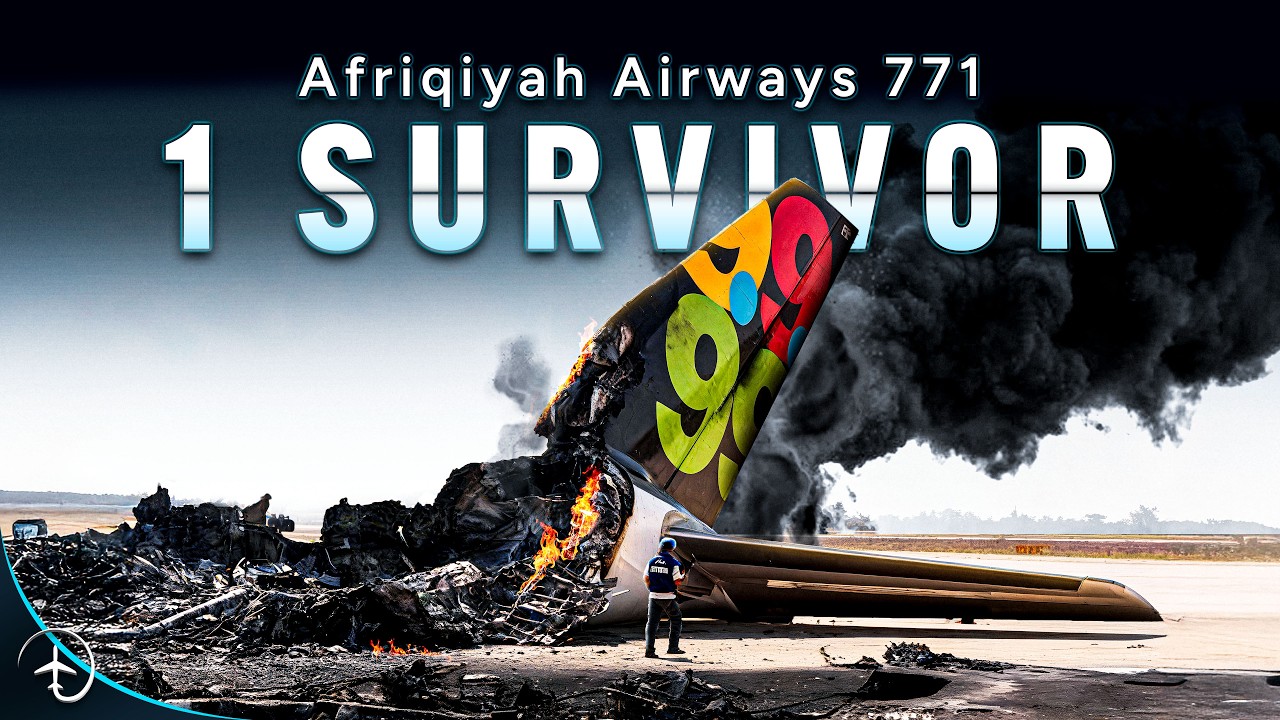
At 04:01:13, Afriqiyah Airways Flight 771 struck the ground 1,200 metres short of Runway 09's threshold at Tripoli, wings level and with the landing gear already retracted, at a speed high enough to destroy the aircraft completely and scatter wreckage across more than 800 metres. Of the 104 people on board, 103 died; the sole survivor was a nine-year-old child, who suffered serious injuries. Investigators identified a tightly interlocked sequence of human factors: crew fatigue during the early-morning circadian low, an incomplete approach briefing, unspoken assumptions about automation, degraded crew coordination, and a late go-around conducted under the grip of spatial disorientation.
The investigation's most sobering conclusion was that no single factor was individually unsurvivable — each could have been caught and corrected had any one of the others not simultaneously been present.
Summarised from Mentour Pilot · 43:00. All credit belongs to the original creators. Streamed.News summarises publicly available video content.