Original source: Mentour Pilot
This video from Mentour Pilot covered a lot of ground. 7 segments stood out as worth your time. Everything below links directly to the timestamp in the original video.
A single phrase — 'cleared for the VOR/DME approach' — meant different things to the pilots and the controller, and 92 people died as a result. Understanding how that happened explains why modern cockpits sound and operate the way they do.
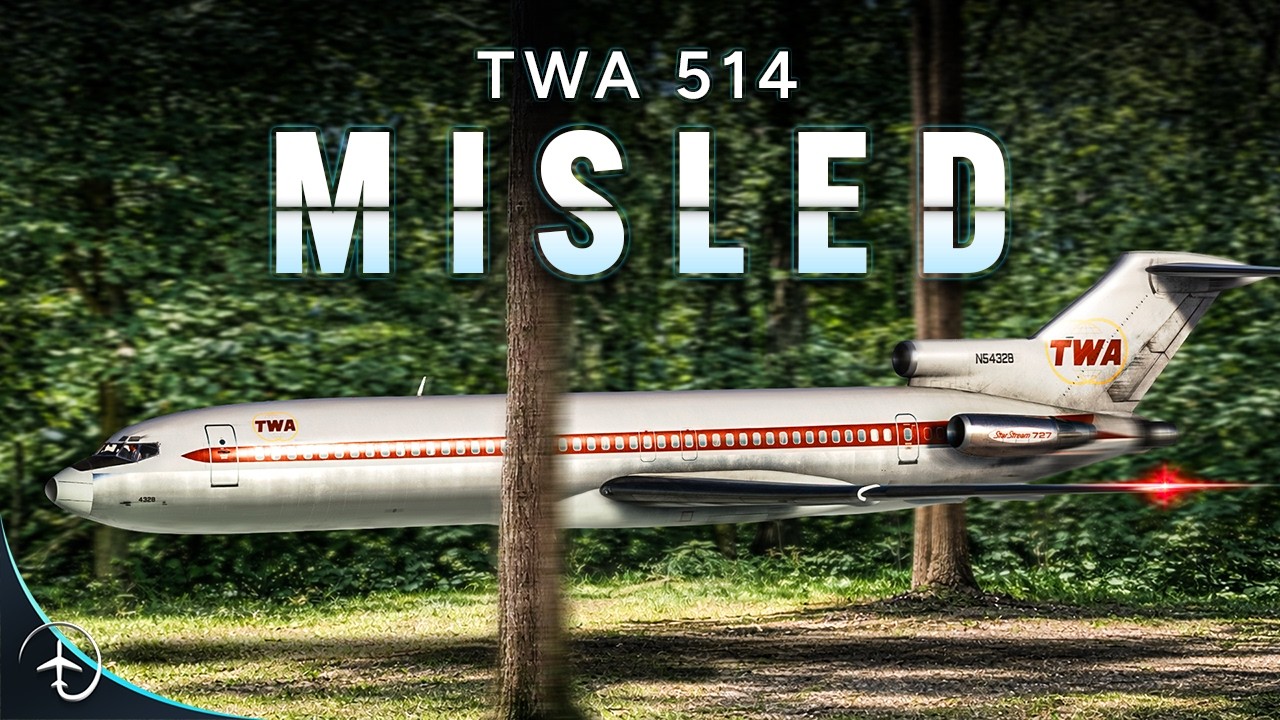
TWA Flight 514 Crashed Into Virginia Mountains After a Single Misunderstood Clearance
On the morning of December 1st, 1974, a TWA Boeing 727 descending toward Washington Dulles Airport in low cloud and strong winds struck the Blue Ridge Mountains after its crew acted on what they believed was permission to drop to 1,800 feet — terrain that reached nearly that same elevation. All 92 people aboard died. The misunderstanding stemmed not from recklessness but from an ambiguity baked into standard phraseology of the era.
What makes this accident significant beyond its immediate tragedy is that the systemic failures it exposed — ambiguous clearance language, misaligned assumptions between pilots and controllers, and absent onboard warnings — reshaped the safety architecture of every commercial flight that followed.
Flight 514 Crew Began Fatal Descent After Interpreting Approach Clearance as Altitude Authorisation
The moment that sealed the fate of TWA Flight 514 came at 11:04 on December 1st, 1974, when Washington Center issued a clearance for the VOR/DME approach to Runway 12 without specifying any altitude restriction. The captain's immediate response — 'eighteen hundred is the bottom' — reflected a widely-held pilot understanding of the era: that an approach clearance constituted permission to descend directly to the procedure's published initial altitude, using what was then known as the 'dive and drive' technique.
This interpretation was not aberrant; it was the industry norm. The stabilised continuous descent approaches standard today were not yet common practice, making early descent to minimum altitude feel not just legal but expected.
"1,800 is the bottom."
Chart Design and Conflicting Definitions of 'Radar Arrival' Placed Flight 514 in Uncharted Danger
The descent to 1,800 feet was only procedurally safe after crossing the initial approach fix at Round Hill — a point Flight 514 had not yet reached. Published segments from the Front Royal VOR required a minimum of 3,400 feet; from Martinsburg, 3,000 feet. But the crew had been vectored directly onto the 300-degree radial for a straight-in intercept, an operationally routine routing that appeared on no chart as a labelled segment with its own minimum altitude. Between their position and Round Hill, the Blue Ridge Mountains reached nearly 1,800 feet.
Compounding this, the NTSB itself split on whether Flight 514 even constituted a radar arrival at the moment of clearance — a disagreement that illustrated precisely how much life-critical ambiguity had been allowed to persist at the centre of standard procedure.
A United Airlines Safety Report Filed Before the Crash Identified the Same Hazard — But Never Left the Company
Weeks before TWA Flight 514 struck the Blue Ridge Mountains, a United Airlines pilot had submitted an anonymous internal report after recognising that he had descended below the minimum safe altitude on the same type of approach at Dulles — also without an explicit altitude restriction, also while still roughly 25 nautical miles from the field. United conducted an internal review and found the pattern was widespread among its own crews. It issued guidance, but the warning never reached the FAA or any other carrier.
At the time, no industry-wide anonymous reporting mechanism existed. Safety intelligence was sealed inside individual companies, which meant a hazard that United had already identified and partially corrected was quietly repeating itself across the system — including at TWA.
An American Airlines Crew Asked the Right Question Thirty Minutes Before TWA 514's Fatal Descent
Thirty minutes before TWA Flight 514 was cleared for its approach, an American Airlines aircraft received an identical clearance for the same Runway 12 procedure, also without a stated altitude restriction. That captain paused and asked the controller directly what altitude he should maintain; the controller replied with the minimum vectoring altitude, and the flight continued safely. Had the TWA crew been on the same frequency, they might have asked the same question. They were not.
Investigators also found that TWA itself had warned the FAA in 1970 — four years before the accident — about the divergent assumptions held by pilots and controllers regarding terrain clearance responsibility. The FAA chose not to act, maintaining that pilots bore ultimate responsibility for their own terrain separation.
Flight 514's Final Seconds: Radio Altimeter Chimed at 500 Feet, Then 100 Feet, Before Impact
As TWA Flight 514 continued its descent through worsening turbulence — the kind generated by strong winds moving over rising terrain — the crew had no system capable of warning them how close the ground had become. The Boeing 727, like every airliner of its era, carried no Ground Proximity Warning System. At 11:09:14, the radio altimeter chimed as the aircraft passed through 500 feet, a reading that startled the crew because they believed they were still ten miles from that altitude on the procedure. Eight seconds later it chimed again at 100 feet. The crew pushed the throttles fully forward, but the engines had no time to spool up. Flight 514 struck the Blue Ridge Mountains at 1,670 feet, killing all 92 aboard.
GPWS, developed by engineer Don Bateman specifically in response to the pattern of controlled flight into terrain accidents, would have generated unmistakable cockpit alerts long before that moment — alerts designed to be loud enough to cut through even severe turbulence.
"Boy! Get some power on!"
TWA Flight 514 Produced Mandatory GPWS, Standardised Phraseology, and the NASA Aviation Safety Reporting System
The NTSB's investigation identified the immediate cause of the accident as the crew's descent below the minimum safe altitude, but traced that descent to a system-wide accumulation of ambiguous air traffic control practices, inconsistent approach clearance definitions, and an absence of any mechanism assigning clear terrain-clearance responsibility. In response, the FAA standardised aviation phraseology by the end of 1975, formally defining what an approach clearance did and did not authorise. It also mandated that controllers issue altitude restrictions whenever radar showed an aircraft approaching unsafe terrain. Most consequentially, the FAA made GPWS mandatory for all turbine airliners, a requirement that took effect in 1975.
The accident also exposed how often crews and controllers recognised hazards but had no safe channel to report them. The result was the Aviation Safety Reporting System, administered by NASA to guarantee anonymity, which remains in operation today and is widely credited with enabling the identification of systemic risks before they produce accidents.
Summarised from Mentour Pilot · 46:19. All credit belongs to the original creators. Streamed.News summarises publicly available video content.