Original source: Mentour Pilot
This video from Mentour Pilot covered a lot of ground. 9 segments stood out as worth your time. Everything below links directly to the timestamp in the original video.
Two aircraft, two altitudes, one fix, one moment — the geometry of disaster was already locked in before either crew had any idea the other was there.
Two Airliners on Collision Course at Same VOR Fix: How a 1965 Near-Miss Began
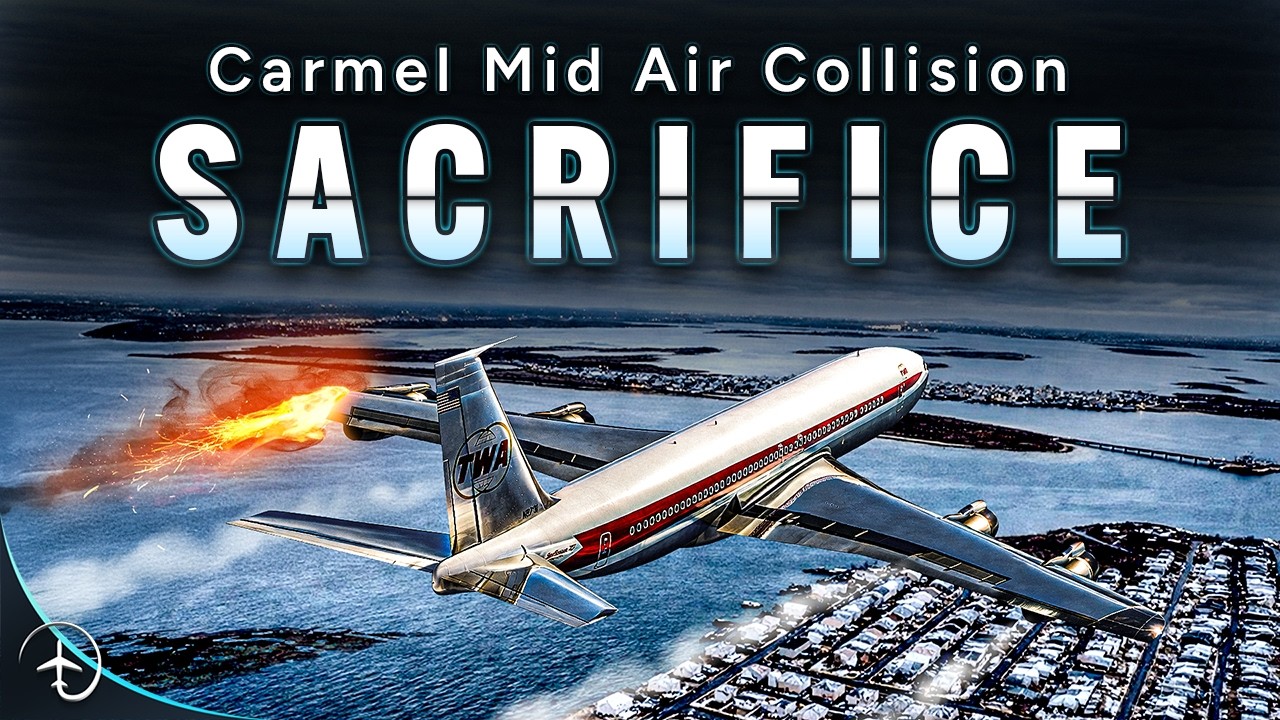
Eastern Airlines Flight 853, a Lockheed Constellation cruising at 10,000 feet, and TWA Flight 42, a Boeing 707 descending with 51 passengers and crew aboard, were both estimated to cross the Carmel VOR navigational fix at the same moment — 16:18 — on the afternoon of the collision. The 707's crew, commanded by a captain with over 18,800 flying hours, had no warning of the threat developing below them as they levelled off at 11,000 feet under radar guidance toward JFK.
The convergence exposed a fundamental weakness of the era: procedural altitude separation existed on paper, but without traffic advisories or collision-avoidance technology, the crews had no means of knowing they were sharing the same patch of sky.
1965 Airspace Rules Treated Safety Layers as Substitutes, Not Shields
In 1965, procedural and visual separation — two distinct methods for keeping aircraft apart — were treated by controllers as interchangeable alternatives rather than reinforcing layers of defence. When procedural separation was in place, controllers routinely withheld traffic advisories, which critically undermined the value of visual separation: pilots who do not know where to look are far less likely to spot conflicting traffic in time. The absence of any equivalent to modern Traffic Collision Avoidance Systems meant that human eyesight, uninformed and unaided, was the final backstop.
The distinction matters because it reframes the 1965 collision not as a simple oversight but as a systemic design flaw — one that modern aviation has since corrected by treating every available safety layer as mandatory rather than optional.
"Visual separation is only effective when the pilots know where to look."
Evidence Points to Optical Illusion, Not Altitude Deviation, as Collision Trigger
Flight data records confirmed that TWA Flight 42 was at its assigned altitude of 11,000 feet at the moment of the incident, while witness testimony and the Constellation's own logbook entries strongly supported that Eastern Flight 853 was correctly positioned at 10,000 feet. With 1,000 feet of vertical separation intact, the aircraft should never have collided — yet the Constellation's first officer perceived an immediate threat and pulled back hard on the controls.
The investigation's task, then, was not to establish a deviation from assigned altitudes but to explain why a correctly separated aircraft appeared, to an experienced pilot, to be on a direct collision course.
False Horizon Created by Cloud Layer Triggered Fatal Evasive Climb, Investigators Find
The investigation concluded that the Constellation's first officer was deceived by an optical illusion. A gradient of cloud tops rising from an overcast layer toward 15,000 feet to the northwest created a false horizon, elevated well above the true one. Because pilots instinctively judge another aircraft's altitude relative to the horizon — expecting an object sitting above it to pass overhead and one below it to pass underneath — the 707, which sat near this false horizon rather than clearly above it, appeared to be at the same level and closing fast. With a sightline rate and range rate consistent with a collision course, the first officer reacted within seconds, pulling back to climb.
What makes this finding particularly significant is that the illusion converted a correctly separated encounter into a real collision: his instinctive climb closed the 1,000-foot gap that procedure had guaranteed.
"If this first officer had been warned to expect a 707 at two o'clock, he still might have second-guessed that reported altitude due to this optical illusion, but that extra couple of seconds would probably have been sufficient for him to realise that the 707 was actually above them."
Evasive Manoeuvres by Both Crews Turned Near-Miss into Collision at 16:18:43
As the Constellation climbed, the 707 crew spotted it emerging from cloud at their ten o'clock position and immediately pulled into a climbing right-hand turn — meaning both aircraft were now ascending toward each other simultaneously. The 707's captain recognised the error at the last moment and pushed the nose down, but the correction came too late. At precisely 16:18:43, the 707's left wingtip struck the Constellation's right horizontal stabiliser, severing 7.6 metres of the jet's wing and shearing off the propeller aircraft's tail surface.
The sequence illustrates the core limitation of uncoordinated visual avoidance: without a system like TCAS to assign opposing manoeuvres to each aircraft, two crews acting independently on the same instinct can transform a recoverable situation into a catastrophic one.
707 Lands Safely at JFK 22 Minutes After Collision Despite Losing 7.6 Metres of Wing
The impact rolled the 707 sharply left and sent it into a dive at around 2.5 G's, but the number one engine had only grazed the Constellation, sustaining superficial damage and continuing to operate. With all four engines producing symmetric thrust, the crew regained control, assessed the damage, overflew JFK once so ground controllers could visually confirm the landing gear position, and then touched down normally at 16:40 — 22 minutes after the collision. All 58 people aboard were unharmed.
The outcome was a product of both skilled flying and circumstance: had the number one engine failed rather than merely scraped, the asymmetric loss of lift and thrust on the already-damaged left wing might have made recovery impossible.
Constellation Crew Saved by First Officer's Improvised Use of Engine Thrust for Pitch Control
After the collision severed the Constellation's right horizontal stabiliser, the aircraft pitched nose-down into a steep dive. The pilots discovered that hydraulic pressure was gone and the trim cables had been cut, leaving them with no conventional means of controlling pitch. In that moment, the first officer suggested pushing the throttles fully forward — reasoning that the engine thrust line might induce a nose-up moment. The captain acted on the idea immediately, the nose rose, and the dive was arrested. Subsequent cycles of testing taught the crew that they could sustain a descent rate of roughly 500 feet per minute while using asymmetric thrust to steer.
The episode stands as an early and vivid illustration of crew resource management in practice: a solution that existed only in the first officer's instinct, accepted by a captain willing to act on it.
"This solution was only discovered thanks to his willingness to listen to the knowledge and experience of the first officer, as well as the first officer's willingness to share his ideas."
Constellation Crew Executes Forced Landing in Sloped Farm Field Near North Salem
Unable to reach Danbury Airport and overflying it at between 2,000 and 3,000 feet, the Constellation's crew located an inclined farm field near North Salem, New York — imperfect terrain, but the best available option in a heavily forested, hilly region. The captain addressed passengers twice, first to warn of the mid-air collision and then to instruct them to brace, while a 22-year-old stewardess improvised by directing panicking passengers to read the safety card, keeping the cabin weight distribution stable. The captain timed a brief burst of full power at the last moment to lift the nose, preventing the aircraft from ploughing nose-first into the rising hillside; the Constellation broke into three sections but remained largely intact.
The landing's success rested on a chain of decisions — the field selection, the passenger management, and the precise throttle timing — each of which, had it failed, would have changed the outcome entirely.
Captain Charles White Dies Entering Burning Wreckage to Free Trapped Passenger
A fire ignited on the Constellation's left side immediately after the crash landing, and most passengers evacuated through breaks in the fuselage. Captain Charles White, who had survived the impact, re-entered the burning aircraft to reach a passenger — possibly a firefighter — whose seatbelt had jammed. Survivors' accounts differ on the precise sequence, but White's body was later found just inside the forward fuselage while the trapped passenger's body lay nearby in the aisle; both died from smoke inhalation. Two further passengers who had been injured during the evacuation died later in hospital, bringing the final death toll to four. White was buried with full military honours.
The death toll of four, against the scale of structural destruction the aircraft suffered, underscores how much the crew's airmanship had already achieved — but it also ensures that the accident is remembered not only as a technical case study but as a human tragedy.
Summarised from Mentour Pilot · 40:34. All credit belongs to the original creators. Streamed.News summarises publicly available video content.